PR: This article contains affiliate links. If you buy a product through a link marked “Ad”, we may receive a commission.
This page is general information from official sources. It is not medical or legal advice. If you feel unwell after drinking, or you are worried about alcohol and your health or medicine, ask a doctor or pharmacist.
Your team has invited you to a nomikai (飲み会), a drinking party after work, and you are not sure what will happen. Some images online may make Japanese drinking culture look extreme, but that is not what everyone does or what is expected of you. This guide covers what to ask before you go, what usually happens at the table, how to say no to a drink, and how to get home in Fukuoka City and Kumamoto City.
In short
- You do not have to drink alcohol. Japan’s health ministry says people should not push others to drink (section 2).
- In Japan you must be 20 or older to drink alcohol, even though adulthood starts at 18 (section 1).
- Before the party, check the fee, how it is paid, and your last train or tram (sections 1, 3 and 4).
- Never drive, and never ride a bicycle, after drinking. Use a train, bus, taxi or a designated driver service (section 5).
Checked with official pages on September 27, 2026.
1. Before you go
What is a nomikai?
A nomikai is a meal with drinks, often at an izakaya (居酒屋), a Japanese pub. The Japan National Tourism Organization (JNTO) says food at an izakaya is meant to be shared, and many izakaya offer nomihodai (飲み放題), an all-you-can-drink plan that usually lasts one to two hours (JNTO: Entertainment and Nightlife).
Whether a nomikai counts as part of your job depends on your company. If you are not sure, ask your manager or the person who invited you. It is fine to ask.
Can I say that I do not drink?
Official rule (Japan)
Yes. Japan’s Ministry of Health, Labour and Welfare (MHLW) says that pushing people to drink should be avoided, including people who do not usually drink. Its drinking guideline also says some people’s bodies break down alcohol weakly, and even a small amount can make them unwell (MHLW: Guideline on drinking with care for health, PDF in Japanese).
The drinking age is 20. When adulthood in Japan became 18 in April 2022, the age limit for drinking and smoking stayed at 20, according to the Government of Japan’s public relations office. If you are 18 or 19, order a soft drink.
What should I ask the organizer?
Plans are different at every company, so ask. These questions cover most of what you need:
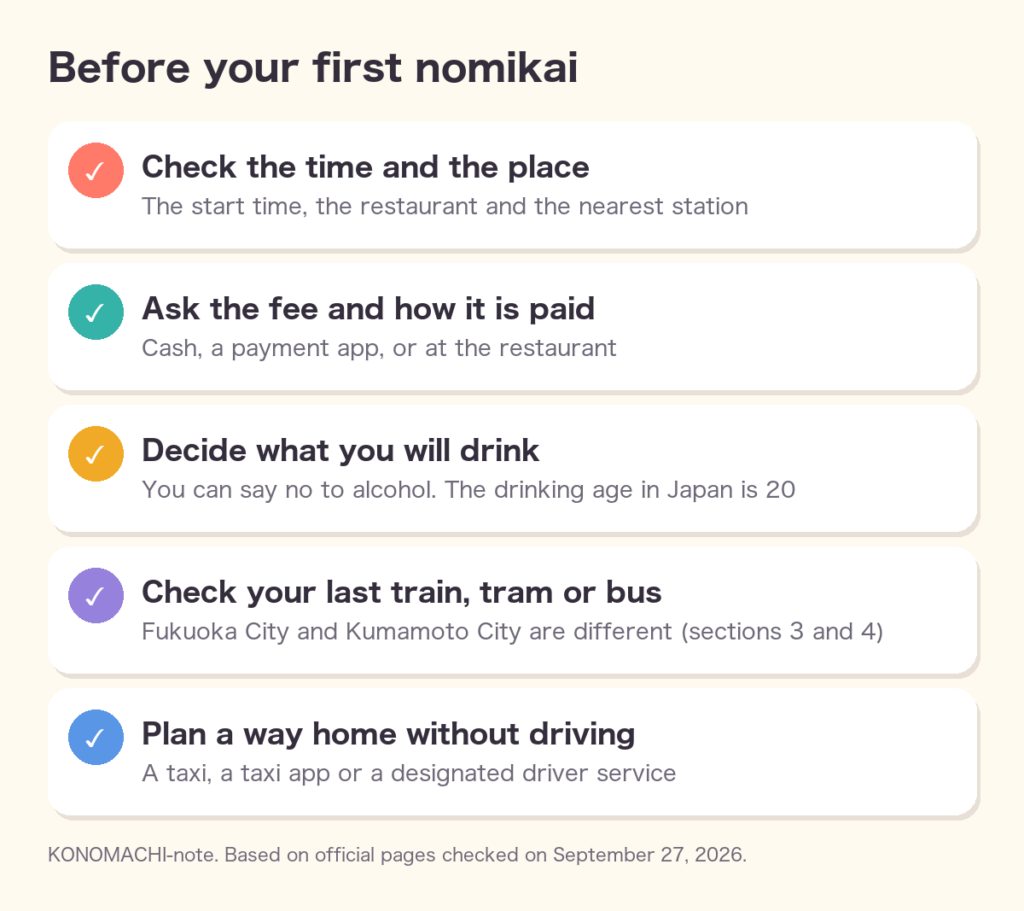
- When and where. The start time, the restaurant name and the nearest station.
- How much, and how it is paid. The fee per person, and whether you pay the organizer in cash, by a payment app, or at the restaurant.
- Is it a set course? Many izakaya offer a nomihodai plan with a time limit.
- Is there a second party? A nijikai (二次会) is a second place after the first one. Ask if you want to plan your trip home.
- What to wear. If you are not sure whether your work clothes are fine, ask.
Then check your last train, tram or bus home. Sections 3 and 4 show where to look in each city.
2. At the table
The toast (kanpai)
Wait for the toast before you drink. JNTO says drinking parties should always have a toast, and it is bad manners to drink before everyone has toasted (JNTO: Drinking the Japanese Way). You can toast with any drink, including tea or juice. People raise their glasses and say “Kanpai!” (乾杯).
Food, the small first dish and sharing
JNTO says some places charge a per-person cover charge, and a small dish, called otoshi (お通し), may arrive before you order (JNTO: Entertainment and Nightlife; Drinking the Japanese Way). Dishes are shared, and each person gets a small plate (取り皿, torizara) to take a portion (JNTO: Izakaya Dining Guide). If you cannot eat some foods, tell the organizer before the party so the course can be checked.
Pouring drinks for others
JNTO describes pouring drinks for others as a sign of respect, and suggests pouring for people who are older or more senior, with both hands (JNTO: Drinking the Japanese Way). When someone pours for you, hold your glass a little tilted (JNTO: Japanese Food Etiquette).
If you do not want more, leave your glass full. JNTO says it is fine not to finish your drink, and an empty glass is a glass that needs refilling.
How to say no to a drink
You can say no clearly and politely, then order something without alcohol. JNTO mentions oolong tea and melon soda as soft drinks you will find at an izakaya.
What to say
お酒は飲めません。ウーロン茶をお願いします。
Osake wa nomemasen. Uroncha o onegaishimasu.
I don’t drink alcohol. An oolong tea, please.
もう十分です。ありがとうございます。
Mo jubun desu. Arigato gozaimasu.
I’ve had enough, thank you.
If someone keeps pushing, you can repeat the same words. MHLW’s guideline says that pushing others to drink should be avoided, and that drinking should not lead to violence, abusive words or harassment.
Pace yourself
Official rule (Japan)
MHLW’s guideline gives simple points for people who drink:
- Eat before or while you drink.
- Drink water (or sparkling water) between alcoholic drinks, drink slowly, or choose a drink without alcohol.
- Avoid drinking a lot in a short time. The guideline says it can cause acute alcohol poisoning.
- Avoid exercise or a hot bath during or after drinking.
Smoking rules
Official rule (Japan)
Since April 1, 2020, Japan’s revised Health Promotion Act makes restaurants non-smoking indoors as a rule. Smoking is allowed only in rooms that meet the law’s conditions, and they must show an official sign. Some small restaurants that were already open on April 1, 2020 may allow smoking under a transition rule. People under 20 cannot enter any smoking area, even if they do not smoke. (MHLW: Key points of the revised law, in Japanese)
Fukuoka City
Fukuoka City bans smoking while walking or cycling on the streets of its no-smoking-on-the-street areas in Tenjin–Daimyo and part of the Hakata Station area. The fine under the city ordinance is up to ¥20,000. In June 2026 the city revised the ordinance to ban all smoking, including heated tobacco, on roads, parks and squares in these areas. The start date of the new rule has not been set yet (Fukuoka City: Revised street smoking rules, in Japanese).
Kumamoto City
Kumamoto City bans smoking on the street inside the Kamitori, Shimotori and Shinshigai arcades. The fine is ¥1,000. Heated tobacco is not covered by the ordinance now, but the city asks people to use it only in smoking areas (Kumamoto City: Street smoking ordinance, in Japanese).
Leaving early and the second party
If you need to leave before the end, tell the organizer or the person next to you, and pay your share if you have not paid yet. If there is a second party, you decide whether to go.
What to say
お先に失礼します。
Osaki ni shitsurei shimasu.
Excuse me for leaving first.
3. Getting home in Fukuoka City
Fukuoka City
This section is for parties in areas such as Tenjin, Nakasu and around Hakata Station. For the routes and IC cards, see Getting around Fukuoka City.
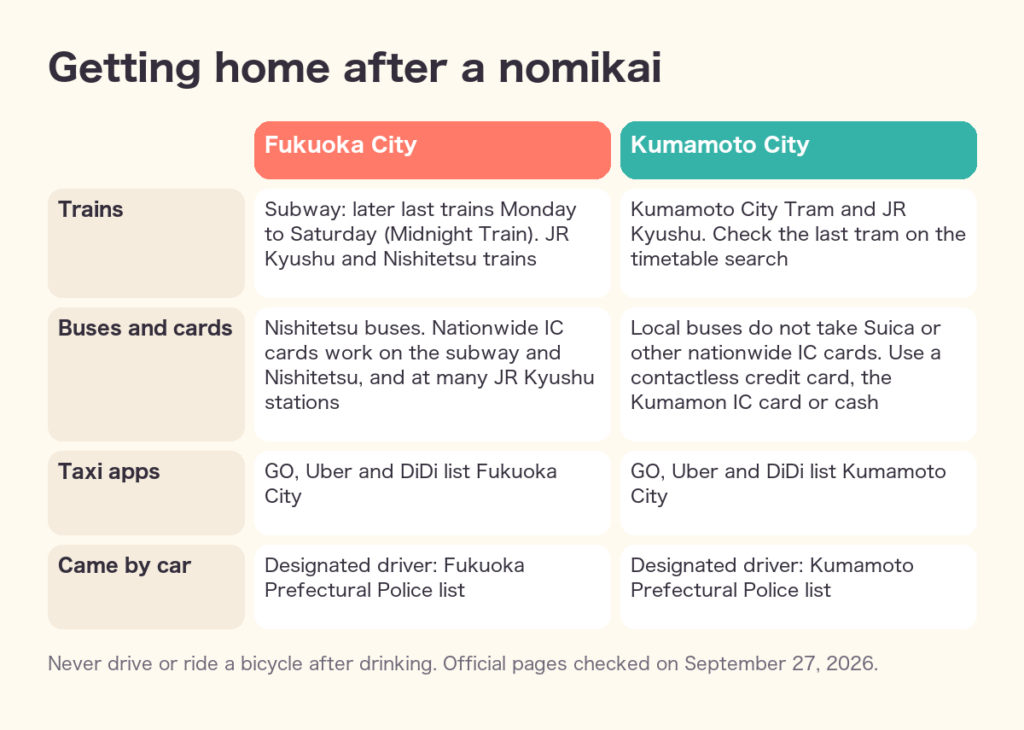
The subway runs later from Monday to Saturday
Since April 1, 2026, Fukuoka City Subway runs “Midnight Trains” on all three lines from Monday to Saturday, with later last trains. In its press release, the subway gave Saturday examples: from Hakata toward Meinohama at 0:40, from Nakasu-Kawabata toward Kaizuka at 0:26, and from Tenjin-Minami toward Hashimoto at 0:33. The last trains toward Hakata and Nakasu-Kawabata are also 10 to 25 minutes later (Fukuoka City Subway: Midnight Train, in Japanese). The station timetables show the same last trains on weekdays. Sundays and national holidays are not included. Check the time for your own station on the station timetables or the English website.
JR, Nishitetsu trains and buses
For JR Kyushu trains, use the JR Kyushu English website (timetable search on the top page). For Nishitetsu trains and buses, use the Nishitetsu timetable and fare search, which works in English. Search for your trip home before the party starts.
Taxis and taxi apps
You can take a taxi from a taxi stand, or book one with an app. GO, Uber (Uber Taxi) and DiDi all list Fukuoka City in their service areas (GO, Uber, DiDi, all in Japanese). GO has an English page that says it accepts international credit cards and Apple Pay. GO says a booking through the app adds a pick-up fee, and the amount depends on the taxi company (GO: Fares, in Japanese).
If you came by car: a designated driver service
A designated driver service (運転代行, untendaiko) sends two drivers. One drives your car home with you in it, and the other follows in the company’s car. You cannot ride in the company’s follow car. Fukuoka Prefectural Police say the average in Fukuoka City is about ¥1,900 for the first 3 km, about ¥2,300 for 5 km and about ¥3,300 for 10 km, and that the company must show you its fee table in advance (Fukuoka Prefectural Police: Designated driver services, in Japanese). The police publish a list of certified companies.
4. Getting home in Kumamoto City
Kumamoto City
This section is for parties in areas such as Shimotori, Kamitori, Shinshigai and around Kumamoto Station. The transport options and the cards they take are different from Fukuoka, so check them before you go.
The tram
Find the last Kumamoto City Tram (熊本市電) from your stop on the Transportation Bureau’s timetable search (in Japanese; choose weekday, Saturday or Sunday and holidays). For fares and payment, see Kumamoto City Tram: fares, payment and how to ride.
Buses: nationwide IC cards do not work
Kumamoto’s local buses do not accept nationwide IC cards such as Suica, SUGOCA, nimoca or Hayakaken. The five bus companies (Kyushu Sanko Bus, Sanko Bus, Kumamoto Electric Railway, Kumamoto Bus and Kumamoto Toshi Bus) take contactless credit cards, the Kumamon IC card (くまモンのICカード) and cash (Kumamoto bus companies: payment methods, in Japanese). Higo Bank, which runs the Kumamon IC card, announced on August 31, 2026 that it will move the card’s services to Kumamon!Pay from March 2027, and that general sales of new cards end on March 31, 2027 (Higo Bank, PDF in Japanese). You can print one timetable for all five companies with My Bus Timetable (Myバス時刻表).
JR trains
If you live along a JR line, check the last train from Kumamoto Station on the JR Kyushu English website (timetable search on the top page).
Taxis, taxi apps and designated drivers
GO, Uber (Uber Taxi) and DiDi all list Kumamoto City in their service areas (GO, Uber, DiDi). If you came by car, Kumamoto Prefectural Police publish a list of certified designated driver companies (as of May 31, 2026), with each office’s phone number where it is given.
5. Staying safe on the way home
Never drive or ride a bicycle after drinking
Official rule (Japan)
The National Police Agency (NPA) says drunk driving is punished with up to 5 years in prison or a fine of up to ¥1,000,000, and driving under the influence with up to 3 years or ¥500,000. People who give alcohol to a driver, or who ride in the car, can also be punished. (NPA: Eradication of Drinking and Driving, PDF)
A bicycle is a vehicle too. The NPA says you must not ride a bicycle after drinking alcohol (NPA: Bicycle rules, in Japanese). This includes shared bikes such as those in our bike-sharing guide.
If you miss the last train
Take a taxi, or book one with an app (sections 3 and 4). If the ride is long, a hotel room near where you are may be another choice. Tell someone from the party, or your family, how you are getting home.
Do not follow street touts
Important
Kumamoto City bans street touting (客引き, kyakuhiki) in designated areas. The city asks people never to follow touts, and says some people who followed touts were overcharged at the place they were taken to. (Kumamoto City, in Japanese) In Fukuoka, Hakata Police Station has a page on touting and other acts banned in Nakasu (STOP! Nakasu, in Japanese).
If someone is very unwell
If a person cannot be woken up or is breathing strangely, call 119 for an ambulance. See Seeing a doctor at night or calling an ambulance in Fukuoka City and Calling an ambulance (119) in Kumamoto City.
If you were pressured to drink
You can talk to your company’s HR team. For questions about working conditions, MHLW runs a Consultation Dial for Foreign Workers in English at 0570-001-701, Monday to Friday, 10:00–15:00 (not 12:00–13:00). Calls are charged: ¥9.35 per 180 seconds from a landline and ¥11 per 20 seconds from a mobile phone (MHLW: Consultation services for foreign workers). For general help in your language, see Help in your language in Fukuoka City or SOUDAN-Plaza in Kumamoto City.
6. Products you may see before a night out in Japan
Some people in Japan drink products such as Ukon no Chikara before or during a night out. The descriptions below are what each maker says. These are foods and drinks, not medicines, so do not use them as a reason to drink more. If you take medicine, are pregnant or have a health condition, ask a doctor or pharmacist first.
| Product | What the maker says it is | Size and price | Before you buy |
|---|---|---|---|
| Ukon no Chikara | A turmeric extract drink (House Wellness Foods) | 100 ml bottle can. Price: Not stated by the maker | Ask a doctor first if you take medicine, see a doctor regularly, or are pregnant or breastfeeding |
| Hepalyse W | A soft drink with liver extract and turmeric extract (Zeria) | 100 ml. Suggested retail price ¥298 (tax included) | The liver extract contains pork |
| Pocari Sweat | A drink to replace water and electrolytes lost in sweat (Otsuka Pharmaceutical) | Bottles in several sizes. Price: Not stated by the maker | The maker says not to take medicine with it |
| Water | MHLW suggests water or sparkling water between alcoholic drinks | — | — |
Ukon no Chikara (ウコンの力)
House Wellness Foods makes this turmeric extract drink. It says each 100 ml contains 30 mg of curcumin and 400 μg of bisacurone from autumn turmeric, plus four B vitamins (Ukon no Chikara product line, in Japanese). The maker gives about one bottle a day as a guide. It also sells granules and tablets.
Ad · Rakuten Ichiba (Japanese site). Prices as of 27 September 2026.
|
|
![[商品価格に関しましては、リンクが作成された時点と現時点で情報が変更されている場合がございます。]](https://hbb.afl.rakuten.co.jp/hgb/57f88516.1760ed53.57f88517.989b354f/?me_id=1235074&item_id=10000029&pc=https%3A%2F%2Fthumbnail.image.rakuten.co.jp%2F%400_mall%2Fpocket-cvs%2Fcabinet%2Fhouse%2F4530503700016-30sm.jpg%3F_ex%3D240x240&s=240x240&t=picttext "[商品価格に関しましては、リンクが作成された時点と現時点で情報が変更されている場合がございます。]")

|
|
![[商品価格に関しましては、リンクが作成された時点と現時点で情報が変更されている場合がございます。]](https://hbb.afl.rakuten.co.jp/hgb/57f880a7.5f855a07.57f880a8.cfef209b/?me_id=1261122&item_id=10243944&pc=https%3A%2F%2Fthumbnail.image.rakuten.co.jp%2F%400_mall%2Frakuten24%2Fcabinet%2F182%2F4530503704182.jpg%3F_ex%3D240x240&s=240x240&t=picttext "[商品価格に関しましては、リンクが作成された時点と現時点で情報が変更されている場合がございます。]")
Hepalyse W (ヘパリーゼW)
Zeria sells Hepalyse W as a soft drink (清涼飲料水). Each 100 ml bottle has liver extract and turmeric extract, with B vitamins. The maker’s page marks it as sold at convenience stores and gives a suggested retail price of ¥298 including tax. The ingredients list shows that the liver extract contains pork. Zeria also sells other Hepalyse products, and some of them are medicines, so read the label of the one you buy.
Ad · Rakuten Ichiba (Japanese site). Prices as of 27 September 2026.
|
|
![[商品価格に関しましては、リンクが作成された時点と現時点で情報が変更されている場合がございます。]](https://hbb.afl.rakuten.co.jp/hgb/57f88ade.19041b89.57f88adf.1fbd24e5/?me_id=1388243&item_id=10000057&pc=https%3A%2F%2Fthumbnail.image.rakuten.co.jp%2F%400_mall%2Fmitubachi1%2Fcabinet%2Fa%2F4987103047933.jpg%3F_ex%3D240x240&s=240x240&t=picttext "[商品価格に関しましては、リンクが作成された時点と現時点で情報が変更されている場合がございます。]")
Sports drinks
Pocari Sweat is one sports drink sold across Japan. Otsuka Pharmaceutical says it replaces water and electrolytes lost in sweat. In its FAQ, the maker says drinking it with alcohol does not make you drunk faster, and that it suits replacing water and electrolytes lost when you drink alcohol. The maker also says not to take medicine with Pocari Sweat (Pocari Sweat FAQ, in Japanese).
Ad · Rakuten Ichiba (Japanese site). Prices as of 27 September 2026.
|
|
![[商品価格に関しましては、リンクが作成された時点と現時点で情報が変更されている場合がございます。]](https://hbb.afl.rakuten.co.jp/hgb/57f88d5f.6fb36c90.57f88d60.1b941cfa/?me_id=1222896&item_id=10001674&pc=https%3A%2F%2Fthumbnail.image.rakuten.co.jp%2F%400_mall%2Fe-convini%2Fcabinet%2Finryou01%2Fimg56412043.jpg%3F_ex%3D240x240&s=240x240&t=picttext "[商品価格に関しましては、リンクが作成された時点と現時点で情報が変更されている場合がございます。]")
Water
MHLW’s drinking guideline suggests drinking water, or sparkling water, between alcoholic drinks so that your body takes in alcohol more slowly. At a nomikai you can ask for water (お水, omizu) at any time.
Ad · Rakuten Ichiba (Japanese site). Prices as of 27 September 2026.
|
|
![[商品価格に関しましては、リンクが作成された時点と現時点で情報が変更されている場合がございます。]](https://hbb.afl.rakuten.co.jp/hgb/57f88eb2.4dca4ebc.57f88eb3.01118306/?me_id=1270768&item_id=10000783&pc=https%3A%2F%2Fthumbnail.image.rakuten.co.jp%2F%400_mall%2Faburajin%2Fcabinet%2Fshohin%2Fsuntory02%2Fst-tennensui2000-12.gif%3F_ex%3D240x240&s=240x240&t=picttext "[商品価格に関しましては、リンクが作成された時点と現時点で情報が変更されている場合がございます。]")
|
|
![[商品価格に関しましては、リンクが作成された時点と現時点で情報が変更されている場合がございます。]](https://hbb.afl.rakuten.co.jp/hgb/57f88e18.9647c54c.57f88e19.26157a4f/?me_id=1235962&item_id=10202026&pc=https%3A%2F%2Fthumbnail.image.rakuten.co.jp%2F%400_mall%2Fkurashikenkou%2Fcabinet%2Fjisyakura2%2Fimgrc0104944489.jpg%3F_ex%3D240x240&s=240x240&t=picttext "[商品価格に関しましては、リンクが作成された時点と現時点で情報が変更されている場合がございます。]")
7. Common questions
I am 19. Can I drink at a work party?
No. The age limit for drinking in Japan is 20. It did not change when adulthood became 18 in April 2022.
Can I sit in the smoking room with my coworkers if I do not smoke?
If you are 20 or older, the law does not stop you. People under 20 cannot enter a smoking area at all, even if they do not smoke, and restaurant staff under 20 cannot either.
Can I ride home in the designated driver’s other car?
No. Fukuoka Prefectural Police say customers cannot ride in the service’s follow car. You ride in your own car, driven by the service’s driver.
Does a sports drink make alcohol work faster?
Otsuka Pharmaceutical says drinking Pocari Sweat with alcohol does not make you drunk faster. It also says alcohol is absorbed faster on an empty stomach. MHLW’s guideline says eating before or while you drink keeps the alcohol level in your blood from rising quickly.
Can I use my Suica card on buses in Kumamoto?
No. Kumamoto’s local buses do not accept nationwide IC cards. Use a contactless credit card, the Kumamon IC card or cash. The Kumamoto City Tram does take nationwide IC cards.
Next steps
Sources (checked September 2026)
- MHLW: Guideline on drinking with care for health (PDF, Japanese)
- Government of Japan: What changes and what does not when adulthood becomes 18 (Japanese)
- JNTO: Entertainment and Nightlife, Drinking the Japanese Way, Japanese Food Etiquette and Izakaya Dining Guide
- MHLW: Key points of the revised Health Promotion Act (Japanese)
- Fukuoka City: No-smoking-on-the-street areas, revised ordinance and ordinance text (Japanese)
- Kumamoto City: Street smoking and littering ordinance (Japanese)
- Fukuoka City Subway: Midnight Train and timetables from April 2026 (Japanese)
- JR Kyushu (English): timetable search and Nishitetsu: Timetable and fare search
- Kumamoto City Transportation Bureau: Timetable search (Japanese)
- Kumamoto bus companies: payment methods and Kumamoto City: My Bus Timetable (Japanese), Higo Bank: moving from the Kumamon IC card to new services (PDF, August 31, 2026)
- GO: Service areas, GO: English page, Uber Taxi: Service areas and DiDi: Service areas, GO: Fares
- Fukuoka Prefectural Police: Designated driver services and certified companies (Japanese)
- Kumamoto Prefectural Police: Certified designated driver companies (Japanese)
- NPA: Eradication of Drinking and Driving and bicycle rules (Japanese)
- Kumamoto City: Do not follow street touts (Japanese) and Hakata Police Station: STOP! Nakasu (Japanese)
- MHLW: Consultation services for foreign workers
- House Wellness Foods: Ukon no Chikara drink, Zeria: Hepalyse W and Otsuka Pharmaceutical: Pocari Sweat FAQ (Japanese)