The Kumamoto City Tram (熊本市電) is the streetcar run by the Kumamoto City Transportation Bureau (熊本市交通局). It has two routes, A and B, and a flat fare for any distance. You pay when you get off.
1. Where does it go?
Route A runs from Tasakibashi (田崎橋) through Kumamoto Station (熊本駅前) and Karashimacho (辛島町) to Kengunmachi (健軍町). Route B runs from Kamikumamoto (上熊本) to Karashimacho, then on to Kengunmachi. The stop names here follow the Transportation Bureau’s English route map.
To travel between the Kamikumamoto side and the Tasakibashi side, you change trams at Karashimacho. You must make the change within 20 minutes.
2. How to ride
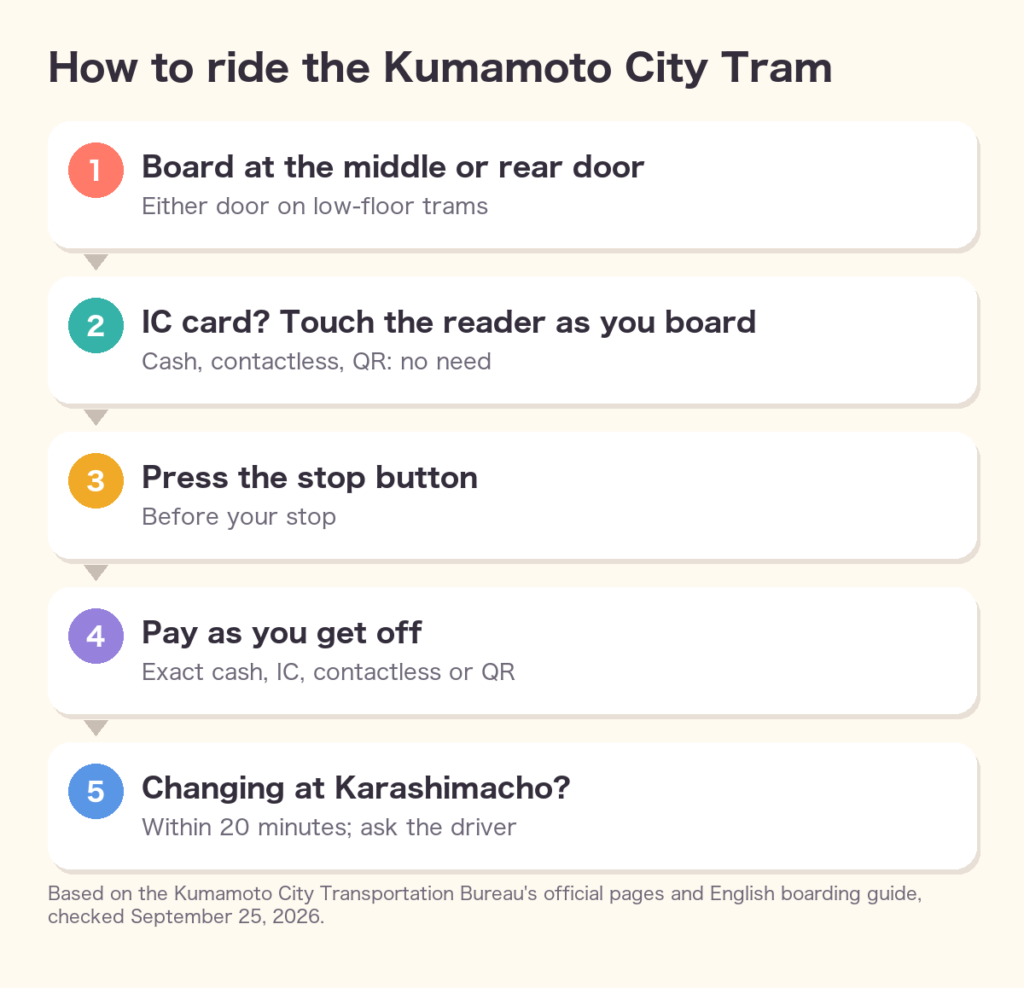
- Get on at the middle or rear door. On low-floor trams you can use either door.
- If you pay with an IC card, touch the reader by the door as you get on.
- Press the stop button before your stop.
- Pay as you get off. Put the exact fare in the fare box, or touch your IC card, contactless card or phone on the reader. For QR code payment, tell the driver first.
If you are paying the child fare, or paying for more than one person with one card, tell the driver before you touch it.
3. Which cards can I use?
The tram takes nationwide IC cards such as Suica, PASMO and nimoca, the local Kumamon IC card (くまモンのICカード), contactless credit cards and many QR code apps. Key facts list them all. This is different from Kumamoto’s local buses and the Kumamoto Electric Railway, which do not accept nationwide IC cards such as Suica.
The fare box gives no change. If you do not have the exact fare, use the change machine on the tram while it is stopped. The Transportation Bureau does not say whether contactless cards issued outside Japan work on its readers.
4. Changing trams at Karashimacho
If you pay by cash, contactless card or QR code, ask the driver for a transfer ticket (乗換乗車券) when you get off the first tram, and give it to the driver when you get off the second one. If you pay with an IC card, touch the reader when you get on the second tram as well.
5. Passes and timetables
A 1-day pass is sold as a paper ticket and in smartphone apps, and a 24-hour pass in apps; the prices are in Key facts. Before you use the paper 1-day pass, scratch off the year, month and day with a coin, then show it to the driver when you get off.
There are separate timetables for weekdays, Saturdays, and Sundays and holidays. Look up times with the timetable search on the Transportation Bureau website, or see where trams are now on the Kumamoto City Tram Navi (熊本市電ナビ).
6. Is there help in English?
The Kumamoto City Tram Boarding Guide, with the route map, fares and how to pay, is a PDF in English, Korean and Chinese on the Transportation Bureau website; the rest of the site is in Japanese. The English guide also says that Kumamoto Free Wi-Fi is available on all trams. The Bureau does not say whether its staff can help in English by phone or on board.
7. From the official account
A Kumamoto City Transportation Bureau post (in Japanese, December 3, 2024) saying the tram still accepts nationwide IC cards such as nimoca and Suica, plus QR codes, touch payment and the Kumamon IC card.
https://x.com/kumamoto_shiden/status/1863768157497995283