This page is general information from the banks’ official pages. It is not financial advice. Each bank decides whether to open an account for you. For your own case, ask the bank.
Your employer asks for a Japanese bank account for your salary, and your phone company and landlord ask for one too. This guide compares nine banks that people in Fukuoka City use: the three mega banks, Japan Post Bank, two Fukuoka-based banks and three online-first banks. It shows who can apply, how, what the fees are, and what happens at the branch. All facts come from each bank’s official pages. When a bank does not say something, we write “Not stated”.
In short
- How long you have been in Japan matters. Several banks treat you differently in your first 6 months unless you work in Japan (section 1).
- With less than 3 months left on your period of stay (3 months or less at Japan Post Bank), Mizuho, Japan Post Bank and Seven Bank do not open an account, so renew your residence card first (section 2).
- Some online sign-ups cannot use residence cards issued on or after June 14, 2026 (section 2).
- MUFG Bank and Nishi-Nippon City Bank ask foreign residents to apply at a branch. Fukuoka Bank’s web sign-up is for Japanese nationals only (sections 5 and 7).
- Bring your residence card and a personal seal. Rubber stamps are not accepted (section 9).
Checked with official pages on September 27, 2026.
1. Which bank fits your situation?
Depends on the bank
Japanese banks follow the same laws, but each bank sets its own rules for foreign residents. Start with your situation below, then check the tables in sections 2 to 4.
- You arrived less than 6 months ago and do not work in Japan yet. MUFG Bank treats you as a “non-resident” under the law, and non-residents cannot apply for some services, such as internet banking and debit cards. SBI Shinsei Bank does not open an account for you, and Sony Bank asks for 6 months in Japan. Japan Post Bank’s page for foreign customers asks for more than 3 months left on your stay and does not mention a 6-month rule.
- You work in Japan. MUFG Bank treats people working in Japan (not part-time or temporary work) as residents from the start. For online sign-ups in your first 6 months, Seven Bank asks for proof of employment. Mizuho Bank asks full-time employees for an employee ID or employment certificate, and others for a copy of their previous residence card.
- You want to apply without visiting a branch. SMBC (app), Japan Post Bank (app), Mizuho Bank (online) and Seven Bank (online or at a Seven Bank ATM) take applications from foreign residents. SBI Shinsei Bank and Sony Bank take them by post.
- You want to talk to someone in your language. Seven Bank says its contact center has multilingual operators. Sony Bank has an English help desk by chat and email. See the table in section 2 for the others.
2. Can I apply, and how?
Depends on the bank
Each bank name links to its official page. These links are not ads.
| Bank | Rules on your time in Japan | How foreign residents apply | Help in English |
|---|---|---|---|
| MUFG Bank | Under 6 months and not working: treated as a non-resident, with limits. 4 months or less left: renew first | Branch only. The app sign-up is not for foreign nationals (FAQ) | Machine translation for some internet banking steps |
| SMBC | An SMBC leaflet says: in principle 6 months since the permission date on your card, and 3 months or more left | App or branch, with a residence card | App main screens in English. Call center and chat: Japanese only |
| Mizuho Bank | Less than 3 months left: not accepted. Online, under 6 months since entry: extra documents (see the Mizuho Bank section) | Online or branch. Both are in Japanese only | App can be switched to English |
| Japan Post Bank | Must be more than 3 months until the end of your stay | App (Yucho Tetsuzuki App) or a Japan Post Bank / post office counter | App in English, Chinese (Simplified) and Vietnamese |
| Fukuoka Bank | Not stated. The bank checks that your period of stay has not expired | Branch counter. Web sign-up: Japanese nationals only. Seven Bank ATM sign-up: needs a My Number Card | Not stated |
| Nishi-Nippon City Bank | Not stated | Branch near your home, work or school. App and ATM sign-up are for Japanese nationals only | Not stated |
| SBI Shinsei Bank | Under 6 months since entry and not working in Japan: cannot open | By post only (branch sign-up ended in July 2026). English application form | English internet banking and web forms. English phone support ended in October 2024 |
| Sony Bank | 6 months or more in Japan | Web application with documents by post | English help desk by chat and email (not by phone) |
| Seven Bank | 3 months or more left. Online, under 6 months in Japan: proof of employment | Online, or at a Seven Bank ATM with only your residence card | English pages; ATM screens in 9 languages; multilingual contact center |
Important
Residence cards issued on or after June 14, 2026. Mizuho Bank’s online sign-up and Seven Bank’s ATM and online sign-ups cannot use residence cards issued on or after June 14, 2026. Seven Bank’s ATM page says this applies “at this time”. Mizuho’s online sign-up also does not take the Specified Residence Card. If your card was issued on or after June 14, 2026, a Mizuho branch may also ask for your passport or a copy of your residence record.
3. What fees will I pay?
Depends on the bank
Note
These are the standard fees on each bank’s fee page. Many banks waive some fees if you meet their conditions, for example a salary deposit or a member stage. All amounts include tax.
| Bank | Transfer fee to another bank (online) | ATM fee at the bank’s own ATMs | Account maintenance fee |
|---|---|---|---|
| MUFG Bank | ¥154 under ¥30,000; ¥220 from ¥30,000 | Free 8:45–21:00; ¥110 at other times (ATM fees) | Paper passbook ¥550 a year (accounts opened from April 2022). Unused 2 years or more: ¥1,320 a year (accounts opened from July 2021) |
| SMBC | ¥154 under ¥30,000; ¥220 from ¥30,000. With an Olive account, free a set number of times a month | Free 8:45–18:00 on weekdays; ¥110 at other times (ATM fees) | Paper passbook ¥550 a year (accounts opened from April 2021). Olive accounts unused 2 years or more: ¥1,100 a year, with exceptions |
| Mizuho Bank | ¥110 | No fee 8:45–18:00 on weekdays; ¥110–¥220 at other times, weekends and holidays (ATM fees) | Paper passbook ¥1,100 each time one is issued or renewed. New accounts have no paper passbook |
| Japan Post Bank | ¥165 (Yucho Direct). To other Japan Post Bank accounts: free 5 times a month | Free at all hours at most ATMs in post offices and Japan Post Bank branches, except for coins (ATM fees) | Not stated |
| Fukuoka Bank | ¥220 under ¥30,000; ¥440 from ¥30,000 (app or internet banking) | ¥110 before 8:45 and after 18:00 on weekdays, and on weekends and holidays (fees) | Unused account fee ¥1,320 a year |
| Nishi-Nippon City Bank | ¥220 under ¥30,000; ¥440 from ¥30,000 | Free 8:45–18:00 on weekdays; ¥110–¥220 at other times (ATM fees) | Unused account fee ¥1,320 a year |
| SBI Shinsei Bank | 1 free a month at the basic stage, then ¥214 | Partner convenience store ATMs: 5 free withdrawals a month at the basic stage, then ¥110 | None |
| Sony Bank | 1 free a month (2 with Sony Bank WALLET), then ¥110 | Partner ATMs: withdrawals free 4 times a month, then ¥110. Deposits free | None |
| Seven Bank | ¥165 (app) | Free 7:00–19:00; ¥110 at other times | Unused 2 years or more: ¥1,320 a year, with exceptions |
“Unused account fee” (未利用口座管理手数料, miriyo koza kanri tesuryo) means a yearly fee on an account with no deposits or withdrawals for a set time. Each bank lists its own conditions and exceptions on the linked page.
4. Can I send money abroad or receive it?
Depends on the bank
An international remittance fee is only part of the cost. When yen are changed into another currency, the bank uses its own rate, which includes a margin. This exchange-rate markup is not shown as a separate fee. Fukuoka Bank, for example, says its selling rate (TTS) includes its exchange fee. Other banks along the way may also take fees.
| Bank | International remittance fee (sending abroad) | Fee when you receive money from abroad |
|---|---|---|
| MUFG Bank | ¥3,000 online; ¥7,000 at a counter. Sending in yen adds 0.05% (at least ¥2,500) | ¥1,500 for a foreign-currency remittance paid into a yen account |
| SMBC | ¥3,500 online; ¥7,500 at a counter (to other banks abroad) | ¥1,500. A remittance in yen adds 0.05% (at least ¥2,500) |
| Mizuho Bank | ¥5,000 in the app; ¥8,500 at a counter (fees) | ¥2,500 |
| Japan Post Bank | ¥3,000 (online service) | US dollars or euros only. The intermediary bank deducts $10 or €5 for amounts over $100 or €100 |
| Fukuoka Bank | ¥2,500 remittance fee plus ¥2,500 cable fee, at a branch after an online pre-application | ¥1,500 if a foreign-currency remittance under ¥750,000 goes into a yen account |
| Nishi-Nippon City Bank | ¥4,500 at a counter | ¥1,500 if the currency is changed and the amount is under US$5,000 (other currencies: under ¥750,000) |
| SBI Shinsei Bank | No overseas remittance is listed in the commission table | ¥2,000 for yen; other currencies have a fee in that currency, such as US$13. Returned at Silver stage and above |
| Sony Bank | ¥3,000, sent from a foreign currency account | ¥0 (banks along the way may take fees) |
| Seven Bank | Western Union service. From ¥400 for up to ¥10,000, depending on country and amount | Not stated |
If you mainly want to bring money into Japan, see our guide How to send or bring money to Japan. It compares Wise, bank transfers, ATM withdrawals and cash.
5. The three mega banks
MUFG Bank
MUFG Bank
MUFG Bank (三菱UFJ銀行) says customers without Japanese nationality cannot use its “Smart Account Opening” app, because it needs to check your details at the counter. Its English page lists what to bring: your residence card, a personal seal and a document showing your My Number. To be treated as a resident, also bring a document showing that you work in Japan or have lived here for 6 months or more; otherwise MUFG treats you as a non-resident, with limits. If 4 months or less are left on your period of stay, MUFG Bank asks you to renew your residence status before you visit. The bank recommends booking your visit. The English page is dated March 4, 2020, so check the Japanese pages as well.
MUFG Bank Fukuoka Branch (三菱UFJ銀行 福岡支店): 1-12-7 Tenjin, Chuo Ward. Counters are open on weekdays, 9:00–15:00. Google Maps. The branch page lists no phone number; it links to an inquiry page instead.
SMBC
SMBC
SMBC (三井住友銀行, Sumitomo Mitsui Banking Corporation) takes applications in the SMBC app. Foreign nationals use a residence card or special permanent resident certificate. SMBC says the account number is sent the same day to about two weeks later, and the cash card arrives in one to two weeks. The app’s main screens can be shown in English, but SMBC says its call center and chat are in Japanese only. SMBC’s leaflet says the residence card should, in principle, show a permission date at least 6 months earlier and have at least 3 months left. SMBC also publishes a sample of the paper form in English for branch applications.
Mizuho Bank
Mizuho Bank
Mizuho Bank (みずほ銀行) says you can apply online or at a branch, but both are in Japanese only. At a branch, bring your residence card and a personal seal. If your status is “Student” or “Technical Intern Training”, also bring a student ID or employee ID. New accounts are paperless (Mizuho e-Account). For an online sign-up in your first 6 months, full-time employees send an employee ID or employment certificate, and others send a copy of their previous residence card. Mizuho says it cannot open an account if less than 3 months are left on your period of stay. After you open an account, tell the bank each time you renew your residence card, or some transactions may be limited.
Mizuho Bank Fukuoka Branch (みずほ銀行 福岡支店): ONE FUKUOKA BLDG., 1-11-1 Tenjin, Chuo Ward. The general reception is on the 8th floor, and the ATM corner on B2 is a separate floor. Counters are open on weekdays, 9:00–15:00. At this branch, overseas remittances are handled by video call and need a booking. Google Maps. The branch page lists no phone number.
6. Japan Post Bank
Japan Post Bank
Japan Post Bank (ゆうちょ銀行, Yucho Bank) accounts can be opened at its own branches and at post office savings counters, or in the Yucho Tetsuzuki App. The app is available in Japanese, English, Chinese (Simplified) and Vietnamese. The app opens only a paperless account, and the bank says the result arrives by email in about a week. At a counter, the bank may not open the account on the same day and may mail the passbook to you later.
- Bring your residence card. If it has no photo, bring another document such as a copy of your residence record.
- If your status is “Student” or “Technical Intern Training”, also bring a student ID or employee ID. The bank has a certificate form that your school or employer can fill in.
- The bank may ask you to come with someone who understands Japanese, because it explains important points in Japanese.
Japan Post Bank Hakata Branch (ゆうちょ銀行 博多店): JRJP Hakata Building 1F, 8-1 Hakataekichuogai, Hakata Ward. The savings counter is open on weekdays, 9:00–16:00. Google Maps. Phone (savings): 0570-080-723 (a paid “Navi Dial” number).
7. Fukuoka’s local banks
Fukuoka Bank
Fukuoka Bank
Fukuoka Bank (福岡銀行) says its web sign-up is for Japanese nationals living in Japan. Its sign-up at Seven Bank ATMs does not list a nationality rule, but it needs a My Number Card with its signature password and an address in Fukuoka, Saga or Yamaguchi Prefecture, in a city or town with a Fukuoka Bank branch. Otherwise, apply at a branch counter. The bank may ask for your reasons and more documents if you choose a branch outside Fukuoka Prefecture. Bring a seal (not a rubber stamp such as Shachihata) and an ID such as your residence card. The bank checks that your period of stay has not expired, and says an account may become unusable once the period it checked has passed. When you renew your card, take the new card, your passbook and your cash card to any Fukuoka Bank branch. Bring your registered seal too if your details have changed or you are closing the account. The bank recommends booking your visit online.
Fukuoka Bank Head Office (福岡銀行 本店営業部): 2-13-1 Tenjin, Chuo Ward. Google Maps. Phone: 092-723-2131 (automated guidance in Japanese).
Nishi-Nippon City Bank
Nishi-Nippon City Bank
Nishi-Nippon City Bank (西日本シティ銀行, NCB) says its app and Seven Bank ATM sign-ups are for Japanese nationals. Other customers apply at the branch nearest their home, work or school. Bring an ID and a seal (not Shachihata). The bank recommends booking, because without a booking you may wait long or not be served that day.
The bank’s head office moved into the new Nishi-Nippon City Building on July 21, 2026. The Head Office and Fukuoka Branch share the 2nd floor. On weekdays from 15:00 to 20:00 and on weekends from 10:00 to 17:00, it takes bookings for business without cash, including opening a new account. Regular counters are open on weekdays, 9:00–15:00.
Nishi-Nippon City Bank Head Office (西日本シティ銀行 本店営業部): Nishi-Nippon City Building 2F, 3-1-1 Hakataekimae, Hakata Ward. Google Maps. Phone: 092-441-2222.
8. Online-first banks
SBI Shinsei Bank
SBI Shinsei Bank
SBI Shinsei Bank (SBI新生銀行) has an English website, English internet banking and an English application form. It does not open accounts for people who entered Japan less than 6 months ago and do not work in Japan. Send a copy of your residence card plus one more ID, such as a driver’s license, a utility bill or a copy of your residence record. If your card does not show a permission date, also send a document showing that you entered Japan 6 or more months ago. From July 2026, non-Japanese customers can apply by post only. The bank says this may take time, so apply early. English phone support ended on October 1, 2024; the bank points customers to its website and web forms instead.
Sony Bank
Sony Bank
Sony Bank (ソニー銀行) is an internet bank. It says anyone living in Japan can open an account, and people without Japanese nationality need to have been in Japan for 6 months or more. Foreign nationals choose the web application with documents sent by post: a copy of the residence card and an original residence record. The bank says the account is ready 3 to 4 days after your papers arrive, and the card comes about 10 days later. Its English online banking ended in late March 2026, and the website now offers machine translation instead. An English help desk still answers by chat and email. Sony Bank limits transactions if it cannot check your renewed residence card before your period of stay ends. Sony Bank WALLET is a cash card with a Visa debit function.
Seven Bank
Seven Bank
Seven Bank (セブン銀行) has ATMs in 7-Eleven stores. Foreign residents aged 16 or older can open an account at a new-type Seven Bank ATM using only a residence card. The ATM screens for this are in Japanese and English. You finish the sign-up from an email link within 24 hours, and the cash card arrives in about two weeks. Online, you need two documents, and proof of employment if you have been in Japan less than 6 months. Accounts opened at an ATM always come with the debit card service. Seven Bank also offers international money transfers, for applicants aged 18 or older.
9. How do I open an account at a branch?
Depends on the bank
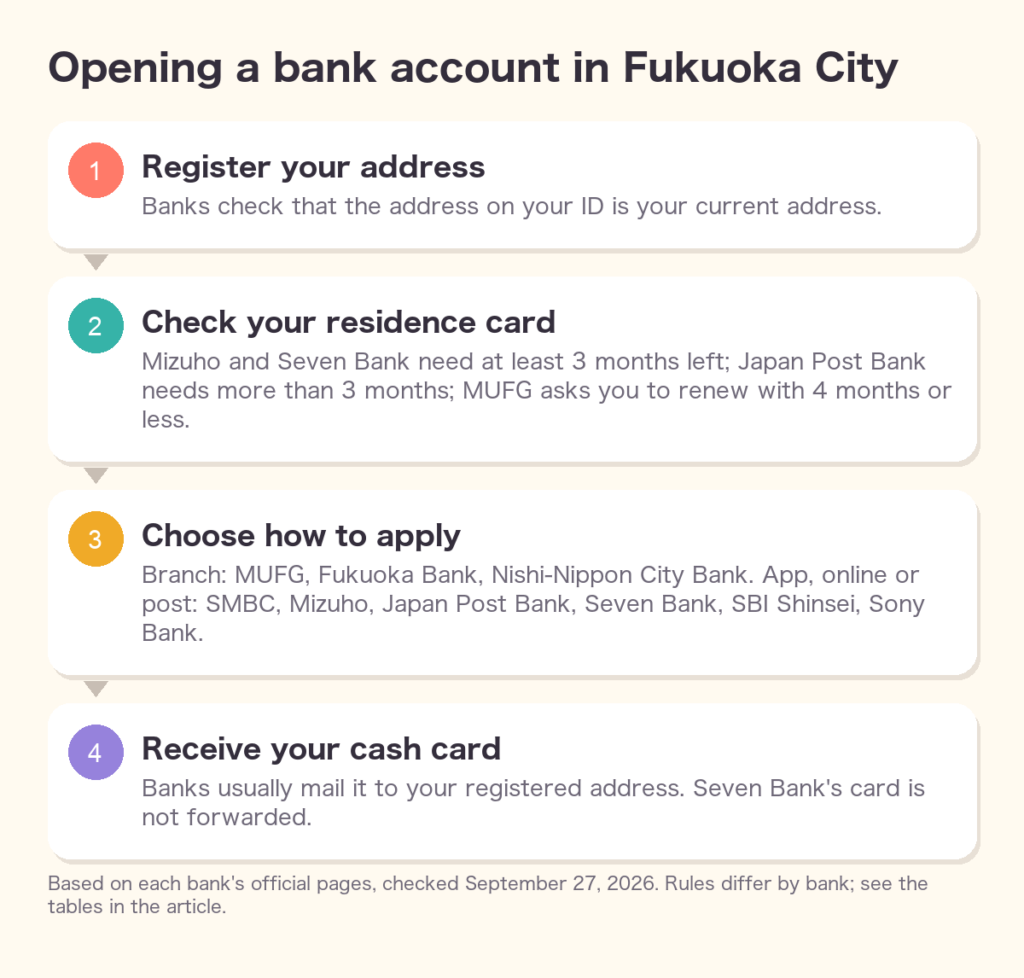
- Register your address first. Banks check that your current address matches your ID. See Registering your address in Fukuoka City.
- Check your residence card. Look at the expiry date. With less than 3 months left, renew first (Mizuho, Seven Bank; Japan Post Bank says 3 months or less; MUFG says 4 months or less).
- Book a visit at a branch near your home or work. MUFG Bank, Fukuoka Bank and Nishi-Nippon City Bank all recommend booking. Local banks may ask why you chose a branch far from home.
- Bring your papers. Your residence card, a personal seal, and what your bank asks for: for example a My Number document (MUFG Bank), or a student or employee ID for “Student” and “Technical Intern Training” status (Mizuho Bank, Japan Post Bank).
- Explain why you need the account. MUFG Bank says it asks the purpose of the account. Answer truthfully.
- Wait for your cash card. Banks usually mail it to your registered address. Seven Bank, for example, says its card is not forwarded, and the account opening is cancelled if you do not receive it.
What to say
口座を開設したいです。
Koza o kaisetsu shitai desu.
I would like to open a bank account.
Important
Why applications are refused. From the banks’ own pages: too little time left on your period of stay; your address or name does not match your ID; less than 6 months in Japan without a job (SBI Shinsei Bank, Sony Bank); a residence card that some online sign-ups cannot read yet; or a rubber stamp instead of a proper seal. Selling, lending or giving your account to someone else is a crime in Japan, and banks warn that you may never be able to open an account again. Close your account when you leave Japan.
10. Common questions
Do I get a paper passbook?
It depends. Mizuho Bank opens paperless e-Accounts and charges ¥1,100 each time a paper passbook is issued or renewed. MUFG Bank and SMBC charge ¥550 a year for a paper passbook on accounts opened since April 2022 and April 2021. Accounts opened in the Japan Post Bank app have no passbook at first; the bank’s app guide says you can switch to a passbook later at an ATM.
What should I do when I renew my residence card?
Tell your bank. Mizuho Bank, Japan Post Bank, Fukuoka Bank and Sony Bank all ask for the new card, and say they may limit transactions if you do not. Japan Post Bank lets you update it in the Yucho Tetsuzuki App or at a counter.
Can I use a stamp from a stationery shop?
A registered seal must not be a rubber stamp. MUFG Bank, Mizuho Bank, Fukuoka Bank and Nishi-Nippon City Bank say rubber stamps such as Shachihata are not accepted.
I am leaving Japan. What should I do with my account?
Mizuho Bank, Japan Post Bank, Seven Bank and Fukuoka Bank ask you to close the account before you move abroad. Fukuoka Bank warns that unused accounts that are sold are used for crimes, and that selling an account is a crime.
Next steps
- Registering your address in Fukuoka City: do this before you visit a bank.
- Help in your language in Fukuoka City: free advice if you are stuck with a letter or a form.
- How to send or bring money to Japan: Wise, bank transfers, ATMs and cash compared.
Sources (checked September 2026)
- MUFG Bank (English): opening a personal account, ID documents, FAQ on the app for non-Japanese nationals, translated pages
- MUFG Bank: transfer fees, ATM fees, other fees, paper passbook fee, foreign exchange fees, Fukuoka Branch
- SMBC: opening an account, account leaflet (PDF), app translation, transfer fees, ATM fees, passbook fee, unused account fee (PDF), overseas remittance, foreign exchange fees (PDF)
- Mizuho Bank: residence card holders, FAQ in English, app in English, transfer fees, ATM fees, foreign exchange fees, app remittance fee, Fukuoka Branch
- Japan Post Bank: foreign customers opening an account, Yucho Tetsuzuki App guide (English, PDF), transfer fees, ATM fees, international remittance, international remittances (English), Hakata Branch
- Fukuoka Bank: opening an account, web sign-up conditions, what to bring, residence card notice (PDF), transfer fees, deposit and ATM fees, sending abroad, receiving from abroad, Head Office
- Nishi-Nippon City Bank: opening an account, internet banking fees, ATM fees, deposit fees, foreign remittance fees, new head office opening (PDF, July 21, 2026), hours and phone (PDF, April 27, 2026)
- SBI Shinsei Bank: documents for foreign nationals, change to account opening (English), commission table (English), account maintenance fee FAQ, end of English phone support
- Sony Bank: opening an account, applying by post, English online banking and machine translation (January 19, 2026), notice to foreign nationals, transfer and ATM fees, sending abroad, receiving from abroad
- Seven Bank (English): opening an account at an ATM, online application, important notes, charges