This page is general information from official sources. It is not financial advice. Fees and exchange rates change every day. For your own case, ask the provider for a quote.
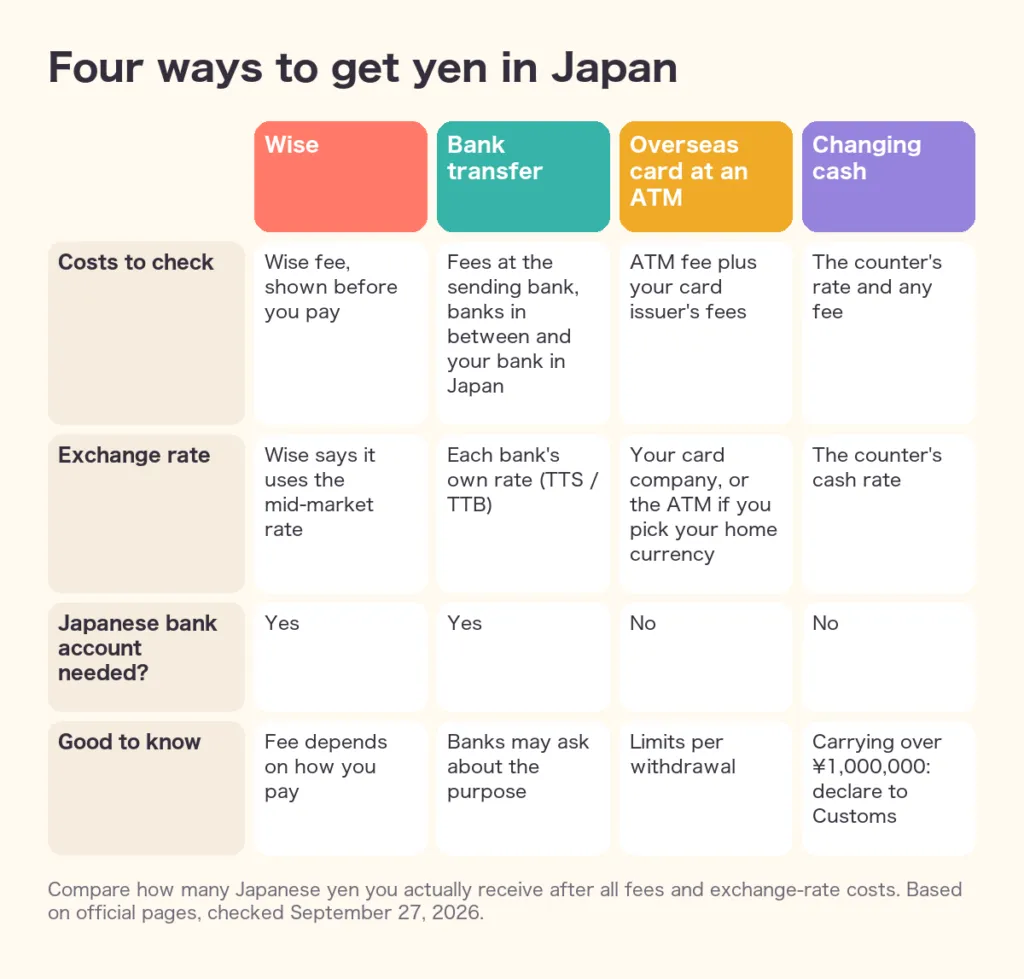
To send money to Japan, the usual ways are a money transfer service such as Wise, a bank-to-bank transfer, or taking yen out of a Japanese ATM with your overseas card. The cheapest way is the one that leaves the most yen in your account after every fee and the exchange-rate markup. For a transfer sent in dollars or euros into a yen account, most Japanese banks in this guide take ¥1,500 to ¥2,500 when it arrives (Sony Bank takes ¥0); a transfer sent in yen often costs more. Japan Post Bank accepts only US dollars or euros.
This guide explains what each way costs and what you need to prepare, for people living in Kumamoto and Fukuoka who need money from home for a rent deposit, furniture or daily costs before the first salary arrives.
In short
- Compare how many Japanese yen you actually receive after all fees and exchange-rate costs. A low fee can come with a weaker rate.
- A bank transfer from abroad can cost fees at three banks: the sending bank, a bank in between and your bank in Japan.
- Japan Post Bank accepts transfers from overseas banks in US dollars or euros only.
- Seven Bank and Japan Post Bank ATMs accept many overseas cards, with limits per withdrawal.
- Carrying more than ¥1,000,000 in cash or equivalent into Japan must be declared to Customs.
Checked with official pages on October 23, 2026.
| Way | Costs to check | Do you need a Japanese bank account? | Good to know |
|---|---|---|---|
| Wise (money transfer service) | Wise’s fee, shown before you pay; it depends on how you pay | Yes, the recipient’s bank account in Japan | Wise says it uses the mid-market exchange rate |
| Bank transfer (international remittance) | Sending bank’s fee, fees of banks in between, your Japanese bank’s fee, and each bank’s exchange rate | Yes | Banks may ask about the purpose and source of the money |
| Overseas card at a Japanese ATM | ATM fee, your card issuer’s fees and rate | No | Limits per withdrawal: ¥50,000 (Japan Post Bank), ¥100,000 (Seven Bank) |
| Changing cash at a counter | The counter’s rate and any fee | No | Counters at Fukuoka Airport’s international terminal |
| Carrying cash | Changing it later | No | Over ¥1,000,000 or equivalent: declare to Customs |
Read next7 pages, swipe sideways
 Year-End and New Year Closures in Kumamoto and Fukuoka (2026–27): Offices, Garbage, Clinics and TransitLive
 Year-End and New Year in Fukuoka 2026–27: Garbage, Transport, First Sales and First Shrine Visits by DateLive
 Shingles Vaccine Subsidies in 5 Kyushu Cities: From ¥3,000, Deadline March 31, 2027Live
 Sick-Child Day Care in Fukuoka City: 21 Rooms, Free for City Residents, with Booking Methods and Saturday HoursLive
 Marriage Registration in Fukuoka City: Night and Holiday Drop-Off, A3 Form With 2 Witnesses, No FeeLive
 Public High School Entrance Exams 2027 in 6 Kyushu Prefectures: Applications, Exam Days and Results ComparedLive
 My Number Card in Fukuoka City: Pickup About 1–2 Months After Applying, and Reservation-Only Weekend CountersLive
How do I compare the ways to send money to Japan?
Depends on the provider
Every way of moving money has two costs. The first is the fee (手数料, tesuryo) that you can see. The second is the exchange-rate markup: the difference between the rate you get and the mid-market rate (the midpoint between the buying and selling rates). Banks do not show the markup as a separate fee. For example, Fukuoka Bank says its selling rate (TTS) and buying rate (TTB) include its exchange fee, and Seven Bank says the rates for its international money transfers include its margin.
- Get quotes for the same amount on the same day. Use the provider’s own calculator or ask the bank.
- Write down every fee. Include the fee to pay in (bank transfer, debit card or credit card), the transfer fee, and fees charged in Japan.
- Check the rate used. Compare it with the mid-market rate on the same day.
- Compare the total yen received for the same total cost. Fix how much you pay in all, fees included, and see how many yen arrive in your account. The option with the most yen costs you the least.
Wise
Wise
Wise is an online money transfer service. Its page on sending money to Japan says the recipient gets yen directly from Wise’s local bank account, and that money can be received into local bank accounts in Japan without a Wise account. Wise says it uses the mid-market exchange rate and shows its fees up front. In Japan, Wise’s service is provided by Wise Payments Japan K.K., registered as a funds transfer service provider (Director-General of the Kanto Local Finance Bureau No. 00040), according to Wise’s Japanese website.
How you pay changes Wise’s fee a lot. On October 23, 2026, Wise’s US page showed these fees for sending 1,000 US dollars to Japan: 4.98 USD using money already in a Wise account, 7.26 USD by direct debit, 11.67 USD by bank transfer, 53.94 USD with a debit card, 66.68 USD with Apple Pay or Google Pay, and 67.03 USD with a credit card. Wise also says that with Apple Pay or Google Pay using a credit card, some banks treat the payment as a cash withdrawal and charge extra. These numbers are only an example from one country on one day; use Wise’s calculator for your own amount.
Wise says speed depends on how you pay. Its help page for yen transfers says that once Wise has received and converted your money, it usually takes 1 working day to reach a Japanese bank account, and the conversion can take up to 2 working days. Wise shows an estimate when you set up each transfer, so check it if you have a payment deadline such as a rent deposit.
What the sender enters for a domestic transfer in Japan: the full account name, usually in katakana and exactly as printed in your bankbook, the account number (usually 7 digits), the account type (普通 futsu for an ordinary account) and the bank and branch. This is different from the English name and SWIFT code that a bank transfer from abroad needs. See Wise’s guide to JPY transfers.
Bank transfer from abroad: receiving fees at Japanese banks
Depends on the bank
With a bank transfer (海外送金, kaigai sokin), your bank at home sends the money through the international banking network to your account in Japan. Your home bank charges an international remittance fee and uses its own rate. Banks in between may deduct fees. Your Japanese bank may also charge a fee when the money arrives.
| Bank in Japan | Fee when you receive (paid by you) | Notes |
|---|---|---|
| MUFG Bank | ¥1,500 | A foreign-currency remittance into a yen account is changed at MUFG’s buying rate (TTB) on the day. Yen remittances cost more |
| SMBC | ¥1,500 | A remittance in yen adds 0.05% (at least ¥2,500) |
| Mizuho Bank | ¥2,500 | Not charged in some cases, such as a yen remittance where the sender pays the fees |
| Japan Post Bank | Not stated on the English page | US dollars or euros only; no yen. The intermediary bank deducts $10 or €5 for amounts over $100 or €100 |
| SBI Shinsei Bank | ¥2,000 for yen; other currencies have a fee in that currency, such as US$13 | Foreign currency goes into a savings account of the same currency. Register your My Number first |
| Sony Bank | ¥0 | 11 currencies, including yen. Banks along the way may take fees |
| Higo Bank | ¥1,500 at the counter | A remittance kept in the same currency, including yen, adds 0.05% (at least ¥2,500) |
| Fukuoka Bank | ¥1,500 minimum charge | For a foreign-currency remittance under ¥750,000 into a yen account. Changed at TTB, which includes the bank’s exchange fee |
| Nishi-Nippon City Bank | ¥1,500 | When the currency is changed and the amount is under US$5,000 (other currencies: under ¥750,000) |
These fees apply when you, the receiver, pay them. Your home bank may let the sender pay instead. Several Japanese banks charge more for a remittance sent in yen than for one sent in dollars or euros, so ask your bank which currency to use.
What the sender needs from you: your bank’s English name and SWIFT (BIC) code, your branch, your account number, and your name and address in English. Japan Post Bank says the name must match the account name in principle. Higo Bank publishes a ready-made guide for senders in English and Chinese.
Note
Japanese banks check incoming remittances under the Foreign Exchange and Foreign Trade Act. Japan Post Bank says it may contact you and ask for documents about the purpose and source of the money, and that this can take more than a month in some cases. Keep your address and phone number up to date with your bank.
Using an overseas card at a Japanese ATM
Depends on the ATM
If you have a bank card or credit card from home, you can take out yen at many ATMs in Japan. You do not need a Japanese account. Your card issuer sets its own fees and rate, so check with them before you travel.
- Seven Bank ATMs (in 7-Eleven stores) accept Visa, Mastercard, UnionPay, American Express, JCB, Discover and Diners Club cards. The limit is ¥100,000 per withdrawal, or ¥30,000 for magnetic stripe cards. Seven Bank says fees for overseas cards vary by card brand. The screens are available in 10 languages.
- Japan Post Bank ATMs accept Visa, Plus, Mastercard, Maestro, Cirrus, JCB, China UnionPay and Discover cards. The limit is ¥50,000 per withdrawal. Japan Post Bank says an ATM fee of ¥220 per use may apply to some overseas cards, plus your card issuer’s fee.
- Mizuho Bank ATMs accept credit cards issued overseas, according to Mizuho’s ATM page. Some MUFG Bank branches have ATMs for overseas cards; the branch pages say which brands.
Important
Yen or your home currency? Seven Bank’s ATMs may ask which currency to use for your bill (Dynamic Currency Conversion, for Visa and Mastercard). If you choose your home currency, the amount is fixed at the ATM; if you choose yen, it is converted later by your card company. Japan Post Bank ATMs may offer the same choice for some cards. Check which rate your card company uses before you choose.
Changing cash at a counter
Depends on the counter
Fukuoka Airport’s official website lists currency exchange counters in the international terminal, including Fukuoka Bank, Travelex, SBJ Bank (Shinhan Bank Japan) and Trip.com. Some bank branches also change foreign cash; Higo Bank’s branch search, for example, lists foreign currency exchange (外貨両替) at its Head Office and Ozu Branch. Each counter sets its own rate for cash. Ask how many yen you will receive for your amount before you hand over the money.
Carrying cash into Japan
Official rule (Japan)
According to Japan Customs, if you enter or leave Japan with means of payment worth more than ¥1,000,000 in total, you must declare them before you enter or leave. This includes Japanese and foreign cash, checks (including traveler’s checks), promissory notes and securities. Gold of over 90% purity weighing more than 1 kg in total must also be declared. Fill in a “Declaration of Carrying of Means of Payment” form, available in the Customs areas at airports and seaports.
What should I prepare first?
Depends on the provider
- Open a Japanese bank account if you want to use Wise or a bank transfer. See Bank accounts in Kumamoto or Bank accounts in Fukuoka City.
- Ask your Japanese bank for its English name, SWIFT code and the currencies it accepts.
- Register your My Number with your bank if it asks for it. SBI Shinsei Bank asks for this before an overseas transfer arrives.
- Tell your card issuer at home that you will use your card in Japan, and ask about its foreign transaction fees.
Common questions
Can I keep the money in dollars or euros in Japan?
Some banks have foreign currency accounts. SBI Shinsei Bank puts incoming foreign currency into a foreign currency savings account of the same currency. Sony Bank lets you receive 11 currencies into yen or foreign currency accounts. Japan Post Bank changes US dollars and euros into yen at its own rate.
Can someone send yen to my Japan Post Bank account from abroad?
No. Japan Post Bank’s English page says remittances from overseas banks are available in US dollars or euros only, not in yen.
Why did my bank transfer arrive with less money than was sent?
Banks in between can deduct their fees from the amount. Japan Post Bank, for example, lists a $10 or €5 charge by its intermediary bank. Your Japanese bank may also deduct its receiving fee (see the table above).
I am leaving Japan. Can I send my money home?
Yes. MUFG Bank, SMBC, Mizuho Bank, Japan Post Bank, Sony Bank and the Kumamoto and Fukuoka banks in our bank guides offer overseas remittances; each has its own international remittance fee. Before you leave, ask your bank what to do with your account. Japan Post Bank, for example, asks customers to close their account when they move out of Japan.
Next steps
Sources (checked October 2026)
12 pages we checked
- Wise: send money to Japan (US page, fees and speed), Wise: send money to Japan (UK page), Wise (Japanese website, registration)
- Japan Customs: export/import of means of payment (FAQ 7305)
- Japan Post Bank: international remittances (English), International ATM Service (English)
- Seven Bank: overseas cards usable at ATMs, how to use the ATM with an overseas card, charges (exchange margins)
- Mizuho Bank: ATM hours and fees, foreign exchange fees
- MUFG Bank: foreign exchange fees, Fukuoka Branch (overseas card ATM)
- SMBC: foreign exchange fees (PDF, February 2026)
- SBI Shinsei Bank: commission table, receiving funds from overseas (FAQ)
- Sony Bank: receiving remittances
- Higo Bank: foreign exchange fees, overseas remittance, branch search
- Fukuoka Bank: receiving from abroad, sending abroad, Nishi-Nippon City Bank: foreign remittance fees
- Fukuoka Airport: banks and currency exchange