The Kumamoto City Tram costs a flat ¥200 for adults and ¥100 for elementary school children, for any distance. You pay when you get off: exact cash, an IC card such as Suica, a contactless credit card, or a QR code app. The tram is run by the Kumamoto City Transportation Bureau on two routes, A and B.
Read next7 pages, swipe sideways
 Rental Cars at 8 Kyushu Airports (2026): Where to Check In, Shuttles and One-Way Rules by CompanyLive
 Taxi Apps and Daiko in the 7 Kyushu Prefectures: Cities with All 3 Apps and Certified Daiko Companies (2026)Live
 16 Highway Bus Routes From Fukuoka: Kumamoto ¥2,500, Nagasaki ¥2,900, With Fares and Travel TimesLive
 Taxi Phone Numbers in Kumamoto Prefecture (2026): Companies and Dispatch Numbers by City and TownLive
 Luggage Storage at Kyushu Shinkansen Stations and Tenjin: Lockers ¥400 to ¥1,200, Staffed Storage From ¥700 a DayLive
 Parking at Kyushu’s Airports: 15 Airports Compared, from ¥500 a Day at Oita to ¥1,800 at Kumamoto (2026)Live
 Year-End and New Year Traffic Jams on the Kyushu Expressway: Inbound Up to 25 km on January 3 (2025-26 Forecast)Live
Where does the Kumamoto City Tram go?
Route A runs from Tasakibashi through Kumamoto Station and Karashimacho to Kengunmachi. Route B runs from Kamikumamoto to Karashimacho, then on to Kengunmachi. The stop names here follow the Transportation Bureau’s English route map.
To travel between the Kamikumamoto side and the Tasakibashi side, you change trams at Karashimacho. You must make the change within 20 minutes, or it does not count as one ride.
How to ride and pay
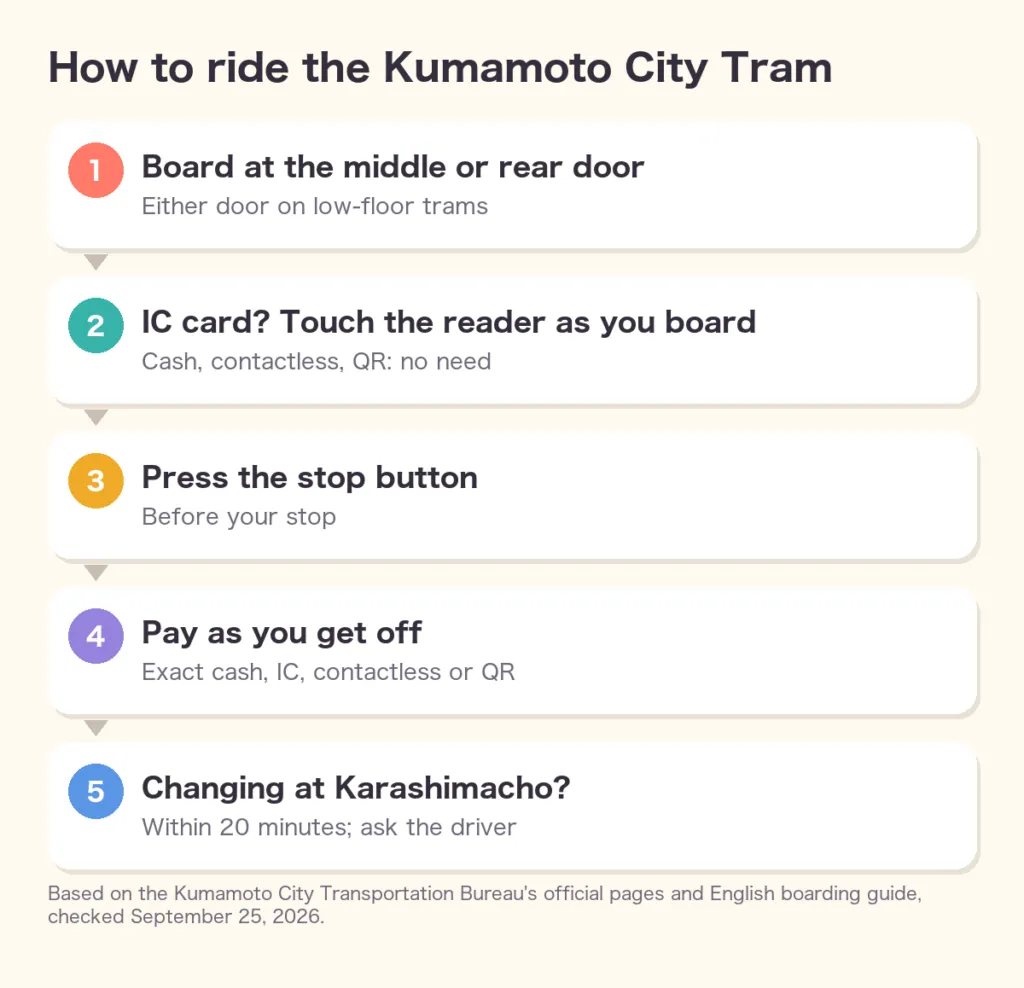
- Get on at the middle or rear door. On low-floor trams you can use either door.
- If you pay with an IC card, touch the reader by the door as you get on. Contactless credit cards and QR codes do not need a touch when you get on.
- Press the stop button before your stop.
- Pay as you get off. Put the exact fare in the fare box, or touch your IC card, contactless card or phone on the reader. For QR code payment, tell the driver first.
There are two ways to pay by QR code. With PayPay, Rakuten Pay, d Barai, au PAY and the overseas brands, you scan the payment QR code inside the tram, enter the fare, and show the screen to the driver when you get off. With the other way, you tell the driver and hold your phone’s QR code up to the camera on the reader.
If you are paying the child fare, or paying for more than one person with one card, tell the driver before you touch it.
Children under elementary school age pay the child fare, but one rides free with each passenger of child age or older. Babies under 1 ride free.
Can I use Suica or a credit card on the tram?
Yes. The tram takes nationwide IC cards such as Suica, PASMO and nimoca, the local Kumamon IC card (くまモンのICカード), contactless Visa, Mastercard, JCB, American Express and other cards, and many QR code apps. Key facts list them all. This is different from Kumamoto’s local buses and the Kumamoto Electric Railway, which do not accept nationwide IC cards such as Suica.
The Kumamoto Kumamon IC card is being replaced by new services. Kumamoto City says you can charge and use it until September 30, 2027.
The fare box gives no change. If you do not have the exact fare, use the change machine on the tram while it is stopped. It takes ¥1,000 notes, not ¥5,000 or ¥10,000 notes. The Transportation Bureau does not say whether contactless cards issued outside Japan work on its readers.
Changing trams at Karashimacho
If you pay by cash, contactless card or QR code, ask the driver for a transfer ticket (乗換乗車券) when you get off the first tram, and give it to the driver when you get off the second one. If you pay with an IC card, touch the reader when you get on the second tram as well. An IC card cannot handle the transfer when you pay for more than one person, or pay the child fare with an adult card; in those cases, take a transfer ticket from the driver.
1-day pass and timetables
A 1-day pass costs ¥500 as a mobile ticket or ¥700 as a paper ticket (children half). A mobile 24-hour pass costs ¥600. The passes are for the tram only, not buses. Before you use the paper 1-day pass, scratch off the year, month and day with a coin, then show it to the driver when you get off. For a mobile pass, show the screen; do not touch the reader.
You can buy the mobile passes in a web browser with QUICK TRIP, or in the Norikae Annai and My route apps. Paper passes are sold at the Transportation Bureau’s sales offices; see the 1-day pass page (Japanese).
There are separate timetables for weekdays, Saturdays, and Sundays and holidays. Look up times with the timetable search on the Transportation Bureau website, or see where trams are now on the Kumamoto City Tram Navi.
Is there help in English?
The Kumamoto City Tram Boarding Guide, with the route map, fares and how to pay, is a PDF in English, Korean and Chinese on the Transportation Bureau website; the rest of the site is in Japanese. The English guide also says that Kumamoto Free Wi-Fi is available on all trams. The Bureau does not say whether its staff can help in English by phone or on board.
From the official account
A Kumamoto City Transportation Bureau post (in Japanese, December 3, 2024) saying the tram still accepts nationwide IC cards such as nimoca and Suica, plus QR codes, touch payment and the Kumamon IC card.
https://x.com/kumamoto_shiden/status/1863768157497995283