This page is general information from city and Ministry of Health, Labour and Welfare pages about the shingles vaccine subsidy. It is not medical advice. For your own case, ask the health department of the city where you live, or your doctor.
The shingles vaccine became a routine (publicly subsidized) vaccination in fiscal year 2025 (FY2025, April to March), and people in the eligible age groups can get it with a subsidy from the city where they live. This page lines up five cities for FY2026: Fukuoka, Kitakyushu, Kurume, Kumamoto and Kagoshima. For each you will find who is eligible, the out-of-pocket cost for each of the two vaccines, the deadline, the conditions for a free shot, and who to contact.
In short
- Eligible: people who turn 65, 70, 75, 80, 85, 90, 95 or 100 during FY2026, and people aged 60–64 with a severe immune disability due to HIV. The subsidy can be used only once.
- Cost: ¥3,000–¥4,950 for the live vaccine (1 dose) and ¥10,000–¥12,000 per dose for the recombinant vaccine (2 doses).
- Deadline: March 31, 2027 in all five cities. The recombinant vaccine needs its second dose by then too, with at least 2 months between doses, so the first dose should be in January 2027 at the latest (Kumamoto City says January).
- People on public assistance and households exempt from resident tax get the shot free in all five cities if they show documents (Kurume requires a procedure in advance).
Checked with official pages on October 27, 2026 (Japan time). Prices and eligibility may change.
Read next7 pages, swipe sideways
 Year-End and New Year Closures in Kumamoto and Fukuoka (2026–27): Offices, Garbage, Clinics and TransitLive
 Year-End and New Year in Fukuoka 2026–27: Garbage, Transport, First Sales and First Shrine Visits by DateLive
 Sick-Child Day Care in Fukuoka City: 21 Rooms, Free for City Residents, with Booking Methods and Saturday HoursLive
 Marriage Registration in Fukuoka City: Night and Holiday Drop-Off, A3 Form With 2 Witnesses, No FeeLive
 Public High School Entrance Exams 2027 in 6 Kyushu Prefectures: Applications, Exam Days and Results ComparedLive
 My Number Card in Fukuoka City: Pickup About 1–2 Months After Applying, and Reservation-Only Weekend CountersLive
 Tax Return Venues in Fukuoka Prefecture: Feb 16 to Mar 15, 2027, Nishitetsu Hall and Admission TicketsLive
1. Out-of-pocket cost in the 5 cities, in one table
The subsidy period is April 1, 2026 to March 31, 2027 in all five cities. You pay ¥3,000–¥4,950 for the live vaccine or ¥10,000–¥12,000 per dose for the recombinant vaccine at the clinic counter. You use one type of vaccine only; switching types between doses is not covered. A shot after the period, or for someone outside the eligible ages, is voluntary vaccination and is paid in full (for Fukuoka’s subsidy for ages 50, 55 and 60, see the Fukuoka section).
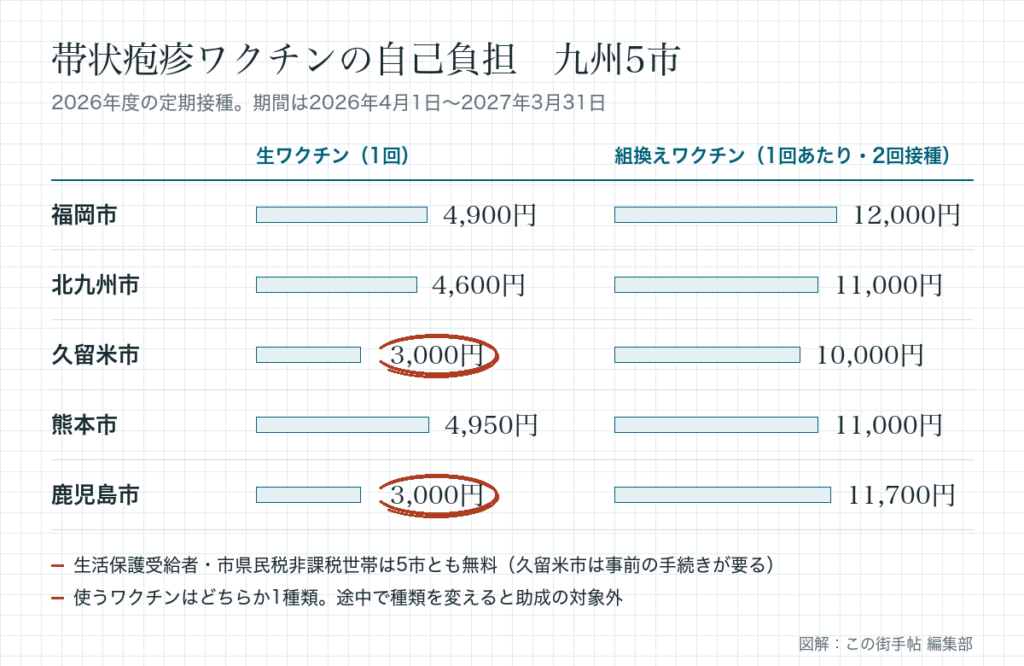
| City | Live (1 dose) | Recombinant (per dose, 2 doses) | Tax-exempt households |
|---|---|---|---|
| Fukuoka | ¥4,900 | ¥12,000 | Free |
| Kitakyushu | ¥4,600 | ¥11,000 | Free |
| Kurume | ¥3,000 | ¥10,000 | Free (apply in advance) |
| Kumamoto | ¥4,950 | ¥11,000 | Free |
| Kagoshima | ¥3,000 | ¥11,700 | Free |
For two doses of the recombinant vaccine you pay ¥24,000 in Fukuoka, ¥22,000 in Kitakyushu, ¥20,000 in Kurume, ¥22,000 in Kumamoto and ¥23,400 in Kagoshima (Fukuoka, Kumamoto and Kagoshima are our calculation from the per-dose amount).
2. Who is eligible in FY2026? Birth dates
In FY2026 the eligible people are those born between April 2, 1961 and April 1, 1962 (age 65), plus those turning 70, 75, 80, 85, 90, 95 or 100 under the five-year transition period that began in FY2025. Birth dates for the transition ages run from April 2 to the following April 1: age 70 is April 2, 1956 – April 1, 1957; age 75 is April 2, 1951 – April 1, 1952; age 80 is April 2, 1946 – April 1, 1947; age 85 is April 2, 1941 – April 1, 1942; age 90 is April 2, 1936 – April 1, 1937; age 95 is April 2, 1931 – April 1, 1932; age 100 is April 2, 1926 – April 1, 1927. You can get the shot before your birthday as long as it is within the period.
People aged 60–64 on the day of vaccination who have a severe disability of immune function due to HIV (roughly equivalent to Grade 1 on the physical disability certificate) are also eligible. People who hold a Grade 1 certificate for other reasons are not. During the transition period you become eligible only once; if you do not get the shot that year, you cannot use the subsidy in later years. Fukuoka and Kitakyushu publish a table showing which fiscal year you become eligible. The Ministry of Health, Labour and Welfare has a page explaining who is covered: Ministry of Health, Labour and Welfare: Shingles vaccine (Japanese)
3. The two vaccines, and who to ask when choosing
The live vaccine is given once, under the skin. The recombinant vaccine is given twice, into the muscle, at least 2 months apart. For people whose immune function is lowered, or may be lowered, by illness or treatment, the interval for the recombinant vaccine can be shortened to 1 month if a doctor judges an early shot necessary. The live vaccine cannot be given to people whose immunity is lowered by illness or treatment.
The Ministry says the two vaccines differ in the number of doses, how they are given, how well and how long they protect, and side effects, and asks people to check these and decide with a doctor. People with heart, kidney, liver or blood diseases, people who had a fever or a body-wide rash within 2 days of a past vaccination, and people who have had convulsions should talk to a doctor beforehand. Decide whether to get vaccinated and which type with your family doctor or the doctor giving the shot. Clinics may stock different vaccines.
For people who paid for a shingles vaccine themselves earlier, the city guidance (Fukuoka and Kurume) is: basically no need to be vaccinated again, but you can use the subsidy if a doctor judges it necessary. The Ministry says people who have had chickenpox or shingles are also eligible for the routine vaccination.
4. Fukuoka City: ¥4,900 live, ¥12,000 recombinant, plus a subsidy from age 50
In Fukuoka City you pay ¥4,900 for the live vaccine or ¥12,000 per dose for the recombinant vaccine, from April 1, 2026 to March 31, 2027 (in principle Monday to Friday). Individual notices were sent to eligible people on April 27–30, 2026. If you choose the recombinant vaccine, get the first dose at least 2 months before the period ends.
Apart from routine vaccination, the city also subsidizes part of the cost of voluntary vaccination for people aged 50, 55 and 60 on the day of the shot (the 55 and 60 groups are a transition measure for FY2025–2029). The period is one year starting the day before the birthday on which you reach that age, and the city shows the same out-of-pocket amounts. A notice arrives at the end of the eligible birthday month.
Book at a participating clinic (look for the sticker “Vaccination (for seniors) participating medical institution”). If your family clinic is outside the city, you can also be vaccinated at clinics in the Fukuoka Prefecture wide-area routine vaccination scheme at Fukuoka City prices. Bring one ID showing your address, name and age (My Number card, health insurance qualification certificate, long-term care insurance card, driver’s licence, etc.) and the questionnaire form that was sent. If you do not have the form, you can use the one kept at the clinic.
People on public assistance, people receiving support benefits for Japanese people left behind in China, and people in households exempt from city and prefectural resident tax pay nothing if they show the latest confirmation documents at the clinic. For exempt households, documents include the long-term care insurance premium notice (income steps 1–3), the late-stage elderly medical insurance certificate (categories I and II), and the long-term care insurance burden limit certificate. If you have none, a resident tax exemption certificate stamped “for vaccination” works (a certificate issued at a convenience store does not). Contact the Health Division of the health and welfare center of your ward: Higashi 092-645-1078, Hakata 092-419-1091, Chuo 092-761-7340, Minami 092-559-5116, Jonan 092-831-4261, Sawara 092-851-6012, Nishi 092-895-7073. Fukuoka City: shingles vaccination, FY2026 (Japanese)
↑ Back to the comparison table
5. Kitakyushu City: ¥4,600 live, ¥11,000 recombinant
In Kitakyushu City you pay ¥4,600 for the live vaccine or ¥11,000 per dose (¥22,000 for two) for the recombinant vaccine, from April 1, 2026 to March 31, 2027. The city said it would send notices to eligible people in early July. Vaccination is individual, at each clinic. Reservations may be needed, so check the list of participating clinics for your ward beforehand.
People on public assistance and people whose whole household is exempt from city resident tax pay nothing. Exempt households show the latest long-term care insurance premium notice (steps 1–3) or the burden limit certificate at the clinic, or take ID and the questionnaire to the health and welfare section of the ward office to have the exemption confirmed. Exempt households in the late-stage elderly medical system can also show a My Number card, or a late-stage medical limit certificate or qualification certificate. People on public assistance show a My Number card or a public assistance certificate.
The city notes that the shingles vaccine can be given at the same time as the flu or COVID-19 vaccine if a doctor considers it especially necessary, and that the live vaccine must be at least 27 days apart from other live vaccines. Questions: Health Planning Division, Public Health Office, Health and Welfare Bureau (093-522-8711). Kitakyushu City: shingles vaccination (Japanese)
↑ Back to the comparison table
6. Kurume City: ¥3,000 live, ¥10,000 recombinant, apply in advance for exemption
In Kurume City you pay ¥3,000 for the live vaccine or ¥10,000 per dose (¥20,000 for two) for the recombinant vaccine, from Wednesday, April 1, 2026 to Wednesday, March 31, 2027. A vaccination ticket (postcard) was sent to eligible people in April 2026; when it arrives, call a clinic to book. You can be vaccinated at a participating clinic in the city or at a clinic in the Fukuoka Prefecture wide-area routine vaccination scheme.
Bring one ID showing your age and that you live in Kurume (My Number card, driver’s licence, etc.) and the ticket postcard. The questionnaire is at the clinic. If you lose the ticket, you can ask for a new one by phone or online application to the Health Prevention Division (it takes about 1 week to 10 days).
Households exempt from city and prefectural resident tax, households on public assistance and households receiving support benefits for Japanese people left behind in China can have the fee waived, but you must apply in advance. Even if you are exempt yourself, the waiver is not available if anyone else in your household pays resident tax. People who had the shingles vaccine as a voluntary shot in the past are in principle not eligible, but are eligible if a doctor judges it necessary. Questions: Health Prevention Division, Public Health Office (0942-30-9730). Kurume City: routine shingles vaccination (Japanese)
↑ Back to the comparison table
7. Kumamoto City: ¥4,950 live, ¥11,000 recombinant, first dose by January
In Kumamoto City you pay ¥4,950 for the live vaccine or ¥11,000 per dose for the recombinant vaccine. The city asks recombinant vaccine users to have the first dose by January 2027 at the latest, so the second can be finished by the end of March. The usual price of the recombinant vaccine is about ¥22,000 per dose, and the city covers half. The city said it would post reminder cards to FY2026 eligible people between late July and early August.
Vaccination is at participating clinics in Kumamoto City; book beforehand using the list of participating clinics for senior vaccination. To be vaccinated outside the city you need a procedure in advance, which takes 1–2 weeks. Bring ID such as a My Number health insurance card. People in households exempt from resident tax, on public assistance, or receiving support benefits for Japanese people left behind in China pay nothing if they show exemption confirmation documents at the clinic. After the shot, receive and keep the vaccination certificate from the clinic.
The city has extended the period for publicly funded vaccination for people hit by the 2026 Kumamoto earthquake who could not be vaccinated during the eligible period and have passed the eligible age (for shingles, one year from July 29, 2026; apply in advance with a disaster victim certificate). Questions: Infectious Disease Prevention Division, Kumamoto City (096-364-3189). Kumamoto City: routine shingles vaccination (Japanese) / Kumamoto City: extension of routine vaccination period (Japanese)
↑ Back to the comparison table
8. Kagoshima City: ¥3,000 live, ¥11,700 recombinant, free for tax-exempt households
In Kagoshima City you pay ¥3,000 for the live vaccine or ¥11,700 per dose for the recombinant vaccine, and the subsidy period is April 1, 2026 to March 31, 2027. People turning 65 and other eligible people were sent a notice and questionnaire in April. If the second recombinant dose falls on or after April 1, 2027, it becomes a voluntary shot paid in full, so the city urges people to consult a clinic early.
People on public assistance and people in households exempt from city and prefectural resident tax (everyone in the household exempt) pay nothing if they show a certificate at the clinic. People on public assistance show either a public assistance certificate or a public assistance medical ticket. Exempt households without a confirmation document can get a “resident tax exemption certificate (for city health programs)” at the City Hall asset tax division, the Taniyama branch tax division or the city tax counter of each branch office. It cannot be issued at convenience stores or city service stations, and for shots from July onward you need the FY2026 version. The National Health Insurance limit certificate does not prove exemption.
Vaccination is at participating clinics in the city or at clinics in the Kagoshima Medical Association reciprocal scheme. Bring the questionnaire and ID showing your age and address, such as a My Number card or driver’s licence. Questions: Infectious Disease Control Division, Public Health Department (099-803-7023). Kagoshima City: routine shingles vaccination (Japanese)
↑ Back to the comparison table
FAQ
What happens if the second recombinant dose is after March 31?
It is no longer subsidized and is paid in full (Fukuoka and Kagoshima guidance). Because you need at least 2 months between doses, the first dose should be by January if you choose the recombinant vaccine (Kumamoto says January).
If I paid for the first recombinant dose myself, can I use the subsidy for the second?
Fukuoka says you can receive the second dose with the subsidy. For other cities, ask the office of the city where you live.
Are earlier fully self-paid shots refunded?
Fukuoka says there is no refund scheme for shots paid in full before routine vaccination began (March 2025 or earlier).
Can I be vaccinated at a clinic outside my city?
Fukuoka and Kurume residents can use clinics in the Fukuoka Prefecture wide-area scheme, and Kagoshima residents can use the Kagoshima Medical Association reciprocal clinics. Kumamoto requires a procedure 1–2 weeks beforehand. Outside the prefecture, check the procedure in advance with your city.
Sources
8 pages we checked
- Ministry of Health, Labour and Welfare: Shingles vaccine (Japanese)
- Fukuoka City: shingles vaccination, FY2026 (Japanese)
- Kitakyushu City: shingles vaccination (Japanese)
- Kurume City: routine shingles vaccination (Japanese)
- Kumamoto City: routine shingles vaccination (Japanese)
- Kumamoto City: extension of routine vaccination period (Japanese)
- Kagoshima City: routine shingles vaccination (Japanese)
- Japanese version of this page (日本語版)
Checked with official pages on October 27, 2026 (Japan time).