This page is a general guide, not advice on your own eligibility. For your case, ask your ward office (contacts are listed under each ward).
Whether you live in Setagaya, Nerima, Edogawa, Adachi or Ota, the fee for licensed daycare (ninka hoikuen) in Tokyo has been ¥0 for every child aged 0–5 since September 2025. This is the Tokyo Metropolitan Government’s free-daycare program for first children. Income and the number of children do not matter, and no application is needed. What remains is the fee for extended care and each center’s actual costs. School-meal costs are free for residents of Setagaya and Nerima. If you cannot get into a licensed center and use a Tokyo-certified center (ninsho hoikusho), all 5 wards pay a subsidy of up to ¥80,000 a month for ages 0–2 in taxed households. The way you receive it (deducted from the fee, or claimed after you pay) and the cap when you have no childcare-need certification differ by ward.
In short
- Licensed daycare: ¥0 for ages 0–5 in all 5 wards, with no application.
- Not covered: extended-care fees and costs collected by each center (hats, events and so on).
- Meal costs: free for residents in Setagaya and Nerima. The Edogawa, Adachi and Ota pages do not say.
- Tokyo-certified centers (ages 0–2, taxed households): up to ¥80,000 a month in all 5 wards. Without a childcare-need certification the cap is lower in Setagaya (¥52,000) and Edogawa.
- Payment method: Adachi deducts it from the fee. Ota and Setagaya pay it after you pay the center.
Checked with official pages on November 1, 2026 (Japan time). Prices and hours may change.
Read next7 pages, swipe sideways
 Postnatal Care in Tokyo: ¥5,000 to ¥9,000 for 2 Days and 1 Night, Charges in 5 Wards and Housework HelpersLive
 Tokyo Zero-Emission Points (2026): Air Conditioners up to ¥70,000 (¥80,000 for Ages 65+), Refrigerators up to ¥80,000Live
 Child Allowance in 5 Tokyo Wards: Apply Within 15 Days, Payment on the 10th in Setagaya and the 12th in NerimaLive
 Tokyo Babysitter Subsidy 2026: Up to ¥2,500 an Hour, with Drop-in Care and Family Support Prices in 5 WardsLive
 Private Kindergarten Subsidies in Tokyo: ¥35,000 to ¥42,300 a Month in Tuition Support, Plus Entrance Fee Support Compared in 5 Wards (2026)Live
 Tokyo’s Kodomo Daredemo Tsuen System (Childcare for Any Child): Monthly Hours and Fees in 15 Wards, Up to 64 Hours (2026)Live
 Solar Panel and Battery Subsidies in Tokyo (2026): ¥150,000 per kW from the Metropolis, 5 Ward Top-Ups and DeadlinesLive
1. Free daycare and certified-center subsidies in 5 Tokyo wards
The basic fee for licensed daycare is free for every child aged 0–5 living in the ward, in all 5 wards, with no paperwork. The differences are meal costs for ages 3–5 and the subsidy if you use a certified center instead of a licensed one.
| Ward | Licensed daycare fee | Meal costs | Certified center (ages 0–2, taxed household) |
|---|---|---|---|
| Setagaya | Free (no application) | Free for residents from September 2025 | Up to ¥80,000 a month (¥52,000 without certification) |
| Nerima | Free (no application) | Waived for residents | Up to ¥80,000 a month |
| Edogawa | Free (no application) | Not stated on the ward page | Up to ¥80,000 a month (with certification) |
| Adachi | Free (no application) | Not stated on the ward page | Up to ¥80,000 a month |
| Ota | Free (no application) | Not stated on the ward page | Up to ¥80,000 a month (paid afterward) |
Extended-care fees are not covered in any of the 5 wards and are paid as before. The subsidy for a certified center is limited to the center’s fee if that fee is below the cap.
2. What changed with Tokyo’s free daycare for first children (from September 2025)
In October 2023 Tokyo began supporting municipalities that make daycare free from the second child (ages 0–2), and in September 2025 from the first child. In municipalities that took part, the licensed-daycare fee became ¥0 regardless of age, income or number of children. Under the national system, ages 0–2 are free only for households exempt from residence tax, the second child is half price if the older child is not yet in school, and the first child pays in full. Tokyo describes its program as its own measure until the national government acts. Free daycare and other fees (Tokyo Bureau of Social Welfare, Japanese)
For certified centers and unlicensed childcare facilities, Tokyo’s diagram shows ¥40,000 of user support (half paid by Tokyo and half by the municipality), plus another ¥40,000 of first-child and multiple-child support paid fully by Tokyo. The total was raised to ¥80,000, which is the cap on a certified center’s fee. Tokyo says the households covered and the amounts differ by municipality.
Ages 3–5 have had free daycare under the national system since October 2019. Tokyo’s new program mainly fills the gap for first children aged 0–2.
3. Even at ¥0, the ward-tax “tier” is still set (it is used for extended care)
Even when the basic fee is ¥0, a tier based on the income-based part of ward residence tax remains, and it is used to calculate extended-care fees and some subsidies. Ota says the fee notice it sent in late September 2025 included the tier used to calculate extended-care fees. How the fee tier is decided and paid (Ota, Japanese)
Tiers change twice a year. April to August is based on the previous fiscal year’s residence tax, and September to the following March on the current year’s (Edogawa, Adachi and Ota pages). Edogawa says no procedure is needed for the free program, but it asks you to file your residence-tax return because the tax amount is used to calculate public funds. If your tax information cannot be confirmed, the highest tier is applied. Your share of the cost (daycare fees) (Edogawa, Japanese)
Before the free program, the fee for a first child aged 0–2 was ¥5,100 to ¥75,500 a month in Adachi. In Ota’s highest tier it was ¥71,800 a month for the 0-year-old class and ¥69,800 for the 1–2-year-old classes. All of that is now ¥0.
4. How to apply in Setagaya, Nerima, Edogawa, Adachi and Ota
Licensed daycare needs no procedure in any of the 5 wards. For certified centers and unlicensed facilities you apply to the ward for the subsidy. For siblings, the oldest child in the household with shared finances counts as the first child (Adachi’s guidance).
Setagaya: both the fee and meal costs are free
From September 2025, Setagaya made daycare free for every child living in the ward who attends licensed daycare and similar centers. From the same time, meal costs for ward residents (staple food and side dishes) are also free, so in principle you pay nothing. Teaching materials, event costs and extended-care fees are not covered. If you live outside the ward, meal costs may apply depending on your own municipality’s rules. Daycare fees and meal costs (Setagaya, Japanese)
If you have been taxed in Setagaya since the previous year, you do not need to submit tax documents. If the ward has no tax information for you, for example because you moved in, you are placed in the highest tier unless you submit a tax certificate or similar. Daycare fee FAQ (Setagaya, Japanese)
For a taxed household using a certified center (ages 0–2) on a monthly contract of 48 hours or more, the subsidy is up to ¥80,000 a month with a childcare-need certification and up to ¥52,000 without one. You pay the center first, apply to the ward, and the ward reviews and pays every 3 months. The final deadline for fiscal 2026 is April 12, 2027. Fee subsidy for unlicensed childcare facilities (Setagaya, Japanese)
Contact: Childcare Certification and Adjustment Division 03-5432-1200; subsidies, Childcare Subsidy Center 03-6453-4990
↑ Back to the comparison table
Nerima: meals are free for residents, cap of ¥80,000 for unlicensed facilities
From September 2025, Nerima made the fee free for first children in taxed households in the 0–2-year-old classes, so the basic fee is ¥0 for every child. Meal costs are waived, and the ward pays all side-dish costs (side dishes and snacks) for ages 3–5 for households living in the ward. If you live outside the ward and use a Nerima center, or use a center in another municipality, meal costs may apply. You pay extended-care fees and the actual costs each center collects, such as hats and events. Fees and side-dish costs at licensed daycare (Nerima, Japanese)
The cap on subsidies for unlicensed childcare facilities, including certified centers, rose from ¥40,000 to ¥80,000 a month in September 2025. Licensed centers, certified children’s centers (nintei kodomoen) and unlicensed facilities need no new procedure for the first-child program. For extended care at Nerima kodomoen (low-age type) and at the age-3 classes of kindergartens, you receive documents from the kindergarten and submit them. Free daycare for first children (Nerima, Japanese)
Contact: Childcare Certification 03-5984-1479; unlicensed facilities including certified centers, Childcare Services Promotion 03-5984-1622
↑ Back to the comparison table
Edogawa: the cap at certified centers depends on certification
From September 2025 usage, Edogawa made the basic fee free at licensed daycare (ward-run and private), certified children’s centers (types 2 and 3) and small-scale community-based childcare. Residents need no procedure. For children who commute from outside the ward, their home municipality sets the fee. Extended-care fees and costs the center collects directly, such as daily supplies, diapers and events, are not covered. Free daycare for first children (Edogawa, Japanese)
For a child aged 0–2 at a certified center in a taxed household with a childcare-need certification, the subsidy is up to ¥80,000 a month with no income limit. Without a certification, it is up to ¥35,000 a month if the household’s income-based ward tax is under ¥77,101, and up to ¥25,000 if it is ¥77,101 or more and under ¥135,000. You apply each fiscal year. If you start using the center in May 2026 or later, submit documents by the end of the month you start. Fee reduction subsidy for certified centers (Edogawa, Japanese)
Contact: Childcare Support Division, Facility Use Benefits 03-5662-1012
↑ Back to the comparison table
Adachi: certified-center subsidy is deducted from the fee
From September 2025, Adachi made the fee free for first children aged 0–2 in taxed households. Its fee table shows ¥0 in every category from first child to third child and later, for ages 0–5. Monthly extended care at ward-run centers (6:30 p.m. to 7:30 p.m.) is ¥1,000 a month for tiers A and B and ¥4,000 for tiers C and D. Publicly owned, privately run centers and private centers set their own. Daycare fees (Adachi, Japanese)
At certified centers, you pay the center its contract fee minus the reduction amount set by the ward. For taxed households with a child in the 0–2-year-old classes, the cap on the reduction is ¥80,000 a month for the first child and for later children. Centers outside the ward are included, and the application form is provided by the certified center you use. Fee reduction (user subsidy) for certified centers (Adachi, Japanese)
For unlicensed facilities other than certified centers (monthly contracts of 120 hours or more), taxed households with a child in the 0–2-year-old classes get up to ¥80,000 a month, paid afterward. Fee subsidy for unlicensed facilities (Adachi, Japanese)
Contact: Childcare and Admissions Division 03-3880-5263
↑ Back to the comparison table
Ota: unlicensed-facility subsidy is paid afterward, babysitters included
Ota made fees free for second and later children in October 2023 and for first children in September 2025, so the monthly fee is ¥0 in every class. Extended-care fees are not covered. How the fee tier is decided and paid (Ota, Japanese)
For certified centers and unlicensed facilities (contracts of 120 hours or more a month), the cap is ¥80,000 a month for the 0–2-year-old classes and ¥77,000 for the 3–5-year-old classes. It is paid after you pay the facility (reimbursement). The subsidy covers the monthly fee and food costs, and extended care and dinner can be included. For one-time care, sick-child care and Family Support, the cap is up to ¥45,700 a month for the 0–2-year-old classes if you have a free-program certification (¥42,000 through September 2026 usage). The babysitter support program (through a partner company) pays up to ¥33,000 a month. Subsidy for unlicensed childcare facilities (Ota, Japanese)
Contact: Childcare Services Division 03-5744-1280
↑ Back to the comparison table
5. Meal costs at daycare differ by ward
Under the national system, side-dish costs for ages 3–5 are not covered. Only households with an income equivalent to under ¥3.6 million a year, and the third and later children in every household, are exempt. Overview of free early childhood education and care (Children and Families Agency, Japanese)
Of the 5 wards, Setagaya and Nerima pay residents’ meal costs, so parents pay nothing. The Edogawa, Adachi and Ota pages do not say how meal costs at licensed daycare for ages 3–5 are handled. Ask the center or the ward office.
6. National cap for unlicensed and one-time care: ¥45,700 and ¥40,300 a month from October 2026
From October 2026 usage, the national cap on facility-use benefits rose to ¥40,300 a month for ages 3–5 and ¥45,700 a month for ages 0–2 in households exempt from residence tax. Adachi’s page says that through September usage the caps were ¥37,000 and ¥42,000. To use it, you need a “childcare need” certification (facility-use benefit certification) before you start. The certification cannot go back before the month you apply. Meals, events and transport are not covered. Free early childhood education and care (Adachi, Japanese)
Ota says that because the national cap rose, it lowered its own ward cap by the same amount, so the combined cap for certified centers and unlicensed facilities (¥80,000 a month for the 0–2-year-old classes) does not change.
7. Cost differences when choosing a daycare or certified center in Tokyo
Now that licensed daycare is ¥0, what changes household costs in Tokyo is the burden at a certified center if you could not get a licensed place, plus meal costs and extended-care fees.
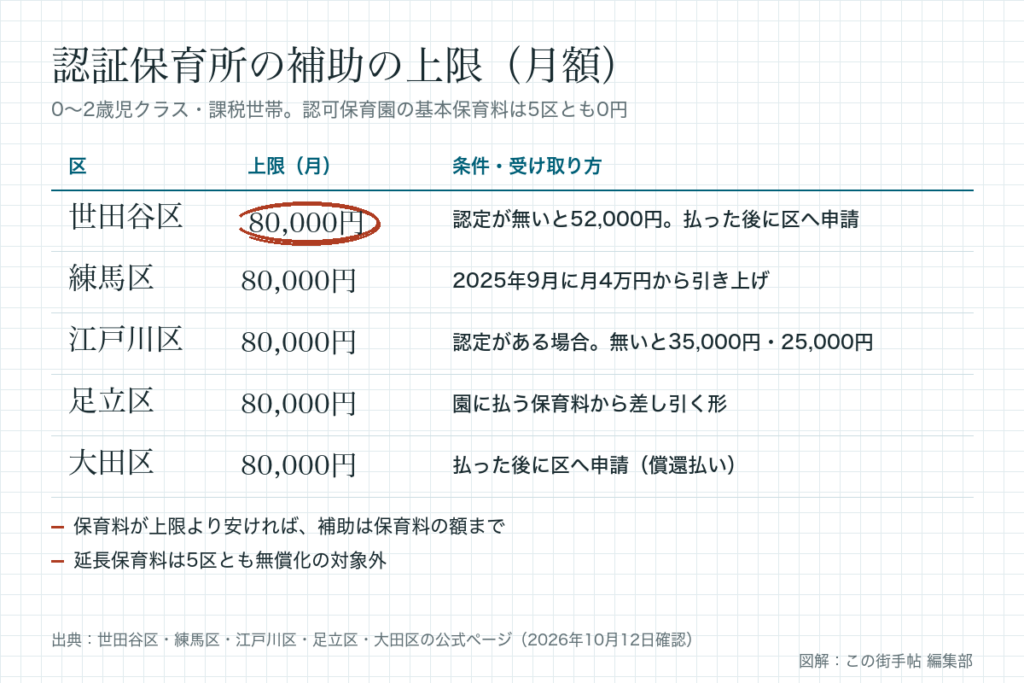
- Tokyo’s diagram shows ¥80,000 a month as the cap on a certified center’s fee. All 5 wards set the subsidy cap for the 0–2-year-old classes in taxed households at ¥80,000 a month, so within that cap your real cost is extended-care fees, entrance fees and other actual costs. In Edogawa and Setagaya, though, the cap is lower without a childcare-need certification.
- The way you receive the subsidy differs by ward. At certified centers in Adachi it is deducted from what you pay the center. In Ota and Setagaya you apply after you pay. In wards that pay afterward, you front several months of fees.
- Free meals depend on being a resident. Setagaya and Nerima both say that children who live outside the ward and attend a center in the ward, or children who attend a center in another municipality, are treated differently. When you move or choose a center near work, check the rules of the ward where you live.
- Tokyo’s free daycare for first children is described as Tokyo’s own measure until the national government acts. The wards’ pages assume Tokyo’s subsidy, so check the ward page at the start of each fiscal year to see whether it continues.
- Applications for admission follow a separate schedule. Deadlines for April 2027 admission are in our page (in Japanese), Daycare admission in Tokyo’s 23 wards, April 2027: first-round deadlines in 5 wards run from October 23 to November 30. Children’s medical fees and Tokyo’s 018 Support are in Tokyo’s 018 Support: ¥5,000 a month, plus children’s medical fees in 4 wards (Japanese).
Common questions
Do I need to apply for free licensed daycare?
No. In all 5 wards, the basic fee for licensed daycare is ¥0 for children aged 0–5 living in the ward, with no application.
What do I still pay at licensed daycare?
Extended-care fees and the actual costs each center collects. Meal costs are free for residents of Setagaya and Nerima.
How much is the subsidy at a certified center?
Up to ¥80,000 a month for ages 0–2 in taxed households in all 5 wards. In Setagaya the cap is ¥52,000 without a childcare-need certification, and Edogawa sets lower caps (¥35,000 or ¥25,000).
Sources
17 pages we checked
- Free daycare and other fees (Tokyo Bureau of Social Welfare, Japanese)
- How the fee tier is decided and paid (Ota, Japanese)
- Your share of the cost (daycare fees) (Edogawa, Japanese)
- Daycare fees and meal costs (Setagaya, Japanese)
- Daycare fee FAQ (Setagaya, Japanese)
- Fee subsidy for unlicensed childcare facilities (Setagaya, Japanese)
- Fees and side-dish costs at licensed daycare (Nerima, Japanese)
- Free daycare for first children (Nerima, Japanese)
- Free daycare for first children (Edogawa, Japanese)
- Fee reduction subsidy for certified centers (Edogawa, Japanese)
- Daycare fees (Adachi, Japanese)
- Fee reduction (user subsidy) for certified centers (Adachi, Japanese)
- Fee subsidy for unlicensed facilities (Adachi, Japanese)
- Subsidy for unlicensed childcare facilities (Ota, Japanese)
- Overview of free early childhood education and care (Children and Families Agency, Japanese)
- Free early childhood education and care (Adachi, Japanese)
- Japanese version of this page (日本語版)
Checked with official pages on November 1, 2026 (Japan time).