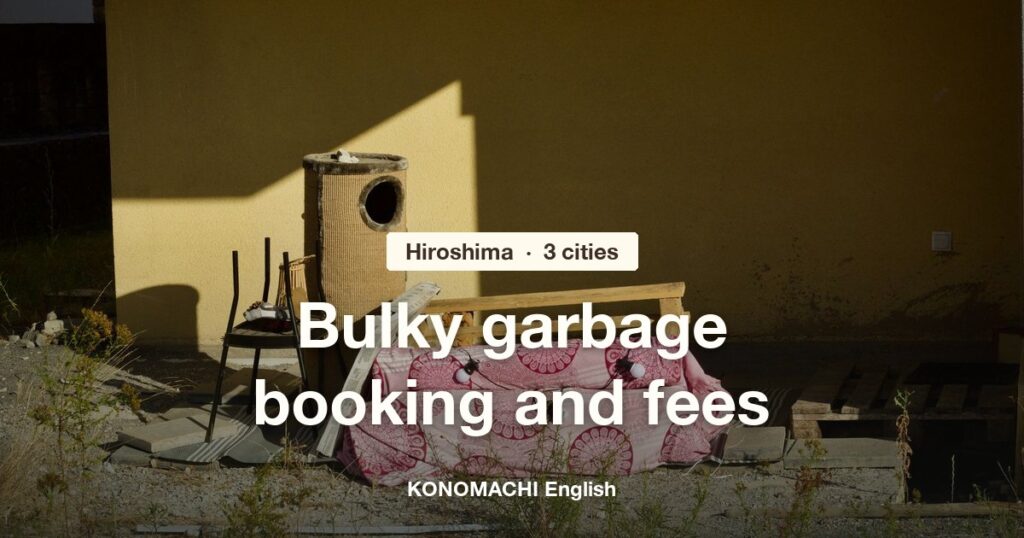
If you are moving into or out of a home in Hiroshima Prefecture, you will probably have a sofa, a bed or a bicycle that does not fit in a garbage bag. Each city has its own name and rules for these items. This page compares Hiroshima City, Fukuyama City and Kure City: how to book a pickup, what it costs, and where to take items yourself. It uses the three cities’ official pages.
In short
- Hiroshima City calls it “Large Waste” (大型ごみ, ogata gomi). Pickup is paid and needs a booking by phone, online or LINE (section 1).
- In Hiroshima City you can also take Large Waste to the Asaminami Plant yourself on weekdays, with no booking and no fee (section 1).
- Fukuyama City picks up “burnable bulky garbage” (wooden furniture and bedding) four times a year, with no booking (section 2).
- Kure City needs no booking: put a ¥300 sticker on each item and put it out on your district’s collection day (section 3).
- Air conditioners, TVs, refrigerators, freezers, washing machines and clothes dryers follow different rules in each city (section 4).
Checked with official pages on October 5, 2026.
| City | Booking | Pickup fee | Take it yourself |
|---|---|---|---|
| Hiroshima | Required (phone, online, LINE) | From ¥250 per item | Asaminami Plant, free |
| Fukuyama | Not needed (4 days a year) | No ticket for pickup | Fee may apply |
| Kure | Not needed | ¥300 sticker per item | ¥160 per 10 kg |
1. Hiroshima City: how do I book Large Waste pickup?
Hiroshima City
Hiroshima City treats an item as Large Waste when its longest side or diameter is 30 cm or more. Pickup is paid and only by booking, and the city’s English guide says it happens twice a month. Items put out without a booking, without enough payment, or without a payment ticket are not collected.
You book with the Large Waste Information Center (大型ごみ受付センター, ogata gomi uketsuke senta). The phone line is open Monday to Friday, 9:00 to 18:00. It is closed on Saturdays, Sundays, holidays, August 6, and December 29 to January 3. The city’s English guide says the phone line is Japanese only. The online form and the LINE web chat take bookings 24 hours a day. The city’s pages do not say whether the online form or the chat can be used in English.
- Book before the deadline. By phone, book at least 3 days before your collection day. Online or by web chat, book at least 5 days before. Count from the day before collection, and skip days the center is closed.
- Say or enter what you are throwing away. The center asks for your address, name, phone number, items and number of items. It gives you the collection day, the place to put the items, the fee and a reception number. Measure cupboards, bookshelves and chests (width and height seen from the front) before you book.
- Pay the fee. Buy a payment ticket (納付券, nofuken) or, if you booked online or by web chat, pay by card or smartphone app (see below).
- Put the items out by 8:30 on the collection day at the place agreed when you booked. Do not put them out before the collection day.
To book on LINE, add Hiroshima City’s account as a friend with the QR code on the city’s page. Then choose “ごみ分別ガイド” (garbage sorting guide) in the menu, then “大型ごみの排出” (putting out Large Waste), then “インターネット” (online) or “ウェブチャット” (web chat). You can also go straight to the online booking site (in Japanese).
One booking can include up to 10 items, and up to 5 of the same item. The total fee for one booking must also be ¥3,000 or less. To add or cancel items, call the center by 18:00 on the day before collection (not counting days it is closed).
How much does it cost?
The fee is set for each item, per piece. Some examples from the city’s fee list:
| Item | Fee per item |
|---|---|
| Futon | ¥250 |
| Microwave oven | ¥500 |
| Bicycle | ¥500 |
| Sofa (1 seat) | ¥500 |
| Single bed (no mattress) | ¥750 |
| Spring mattress | ¥1,250 |
Chests of drawers, shelves and tables are priced by size, so check the full fee list (in Japanese). The center also tells you the fee when you book.
How do I pay?
Payment tickets come in ¥250 and ¥1,000 values. They are sold at convenience stores (7-Eleven, Daily Yamazaki, FamilyMart and Lawson), many supermarkets, and the ward offices’ Ward Administration Coordination Divisions (区政調整課) and branch offices. Look for a sticker at the store entrance that says it sells them. Tickets are cash only and generally cannot be refunded, so book first and buy only what the center tells you. Write your reception number or your name on each ticket and stick it on the item. Keep the receipt until the items are collected.
If you booked online or by web chat, you can choose cashless payment instead: Visa, JCB or Mastercard, or PayPay or merpay. Pay by 0:00 (midnight) at the start of the collection day. You cannot get a refund or change the amount after paying. Instead of a ticket, write your 4-digit reception number and the collection date on a sheet of paper (about A5 to A4 size) in permanent marker, and tape it to each item on all four sides.
Tip
If you live alone and cannot carry Large Waste out of your home, Hiroshima City’s “Anshin Support” (あんしんサポート) carries it out for you for free. Some households where people are 65 or older, have a disability certificate, are pregnant or have a baby under 1, or are children may also qualify. You still pay the normal fee. Apply to the Large Waste Information Center by phone or online at least 2 weeks before your collection day.
Can I take Large Waste there myself?
Yes. People living in Hiroshima City can take Large Waste from their own home to the Asaminami Plant Large Waste Crushing Facility (安佐南工場大型ごみ破砕処理施設). On weekdays you need no booking and pay no disposal fee. It accepts items Monday to Friday, 9:00 to 16:00, and is closed on weekends, holidays, August 6, and December 29 to January 3. You fill in an application form there (or print it from the city’s page first), and staff may ask to see a driver’s license to check that the waste comes from your home in the city. As a rule, you unload the items yourself.
The city says the facility is often crowded from 10:00 to 12:00 and 14:00 to 15:00, and the wait can be 30 minutes or more. Some car navigation systems do not find the plant because the address changed in 2015; the city suggests searching for the Asaminami Environment Office (安佐南環境事業所) about 50 m away.
If you cannot go on a weekday, the plant also opens on some holidays for residents who book online in advance. It is free, 9:00 to 16:00. The remaining dates in fiscal 2026 are Monday, October 12, 2026; Monday, November 23, 2026; Tuesday, December 29, 2026; Monday, January 11, 2027; Thursday, February 11, 2027; and Monday, March 22, 2027. Booking opens about two weeks before each date and closes at 17:00 the day before. There is no phone, fax or email booking for these days.
Asaminami Plant Large Waste Crushing Facility: 3990 Tomokita 4-chome, Asaminami-ku, Hiroshima City. Google Maps. Phone: 082-848-1114.
2. Fukuyama City: when can I put out bulky garbage?
Fukuyama City
In Fukuyama City, the bulky items the city picks up are “burnable bulky garbage” (燃やせる粗大ごみ, moyaseru sodai gomi): wooden furniture and bedding. There is no booking, but pickup is only four times a year, by 8:00 in the morning at a set collection point. The collection point can be different from your usual garbage station.
- Find your schedule. On the city’s 2026 household garbage schedule page (in Japanese), find your town name (町名) and open the “燃やせる粗大ごみ等収集日程表” PDF for your school district. It lists the four dates and the collection points.
- Prepare the item. For cupboards and chests, the city asks you to remove glass and metal parts as far as you can.
- Put it out by 8:00 on the date, at the collection point for your neighborhood.
Metal items are sorted differently. According to the city’s sorting dictionary, bicycles and pipe beds are “non-burnable (crushed) garbage” (不燃(破砕)ごみ), not bulky garbage. Electric beds are not collected.
You can also take burnable bulky garbage to the Fukuyama Rose Energy Center (福山ローズエネルギーセンター, formerly ふくやま環境美化センター) or the Keiohama Landfill (慶応浜埋立地). The city says a disposal fee may apply and asks you to contact the facility before you go. The Rose Energy Center is open Monday to Friday, Sundays and some holidays; the Keiohama Landfill is open Monday to Friday and some holidays. Both accept waste from 8:45 to 16:45. Check the city’s list of holiday opening days before going on a holiday.
Fukuyama Rose Energy Center: 107-14 Minoki-cho, Fukuyama City. Google Maps. Phone: 084-981-2020. Keiohama Landfill: 2285 Yanaizu-cho, Fukuyama City. Google Maps. Phone: 084-934-3247.
3. Kure City: how do I put out bulky garbage?
Kure City
In Kure City, anything that does not fit in a designated garbage bag is bulky garbage (粗大ごみ, sodai gomi). Examples on the city’s English page are furniture, carpets, heaters, bicycles, futons and mattresses. There is no booking, but each item needs a ¥300 oversized garbage sticker, or it is not collected.
- Buy stickers. Buy one ¥300 sticker per item at a dealer that sells Kure City designated bags and stickers. Long items need two stickers (¥600). The city’s pages say “2 m or longer” in one place and “over 2 m” in another, so check the city’s A-to-Z sorting list (ごみ出し・分別あいうえお表) for your item.
- Prepare the item. Tie carpets and futons with string. Remove kerosene and batteries from heaters.
- Put it out by 8:30 on your district’s bulky garbage day, at your usual garbage station. Not the night before.
Collection days depend on the district and are on Kure City’s garbage calendar for fiscal 2026 (ごみ出しカレンダー). For example, the calendar lists the third Wednesday for some districts and the first Wednesday for others. Do not put electrical items with a built-in rechargeable battery out as bulky garbage.
You can also drive items to the Clean Center Kure (クリーンセンターくれ) yourself. It accepts waste Monday to Saturday, 8:30 to 12:00 and 13:00 to 16:30, and is closed on Sundays, holidays and December 31 to January 3. The fee is ¥160 per 10 kg, even if you already used bags or stickers. Come by car or truck (trucks up to 2 tons); you cannot bring waste on foot, by bicycle or by motorbike. There are daily limits, such as 30 futons, 5 mattresses or spring sofas, and 5 bicycles.
Clean Center Kure: 3-9-3 Hirotagaya, Kure City. Google Maps. Phone: 0823-74-9106.
4. What about air conditioners, TVs, fridges and washing machines?
Depends on the city
Air conditioners, TVs, refrigerators, freezers, washing machines and clothes dryers fall under Japan’s Home Appliance Recycling Law, so you pay a recycling fee. Each city handles them differently.
- Hiroshima City collects them as Large Waste if you book. The collection fee is ¥3,000 per item, plus a home appliance recycling ticket that you pay for at a post office. The city notes that the recycling ticket shows your name, address and phone number and stays on the item outside. You can also ask the store that sold it to take it back, or take it to a designated drop-off point yourself.
- Fukuyama City does not collect them. Buy a recycling ticket at a post office and take the item to one of the two designated drop-off points listed on the city’s page, or ask a store.
- Kure City does not collect them. Ask the store where you bought it, or an electrical goods store, to take it back.
Hiroshima City and Kure City do not collect personal computers or monitors either. Ask the maker or a store.
Common questions
Can I put Large Waste out in Hiroshima City without booking?
No. Hiroshima City does not collect Large Waste that was put out without a booking with the Large Waste Information Center.
Can I get a refund for a Hiroshima City payment ticket I did not use?
As a rule, no. The city says tickets generally cannot be refunded, and asks you to book first and check how many tickets you need.
How do I put out a bicycle in Fukuyama City?
Fukuyama City’s sorting dictionary lists bicycles as non-burnable (crushed) garbage, so they go out on the non-burnable collection day, not with burnable bulky garbage.
Can I walk or cycle to the Clean Center Kure with my garbage?
No. Kure City says waste must come by car or truck, not on foot, by bicycle or by motorbike.
Sources (checked October 2026)
- Hiroshima City: Booking and putting out Large Waste (大型ごみ収集の予約・排出方法) and fee list by item (品目別一覧表)
- Hiroshima City: Where to buy payment tickets (納付券の販売場所) and cashless payment (キャッシュレス決済)
- Hiroshima City: Taking Large Waste in yourself (大型ごみの自己搬入) and holiday openings for booked residents (休日開場)
- Hiroshima City: Anshin Support (大型ごみ排出支援事業) and home appliance recycling items (家電リサイクル法対象機器の処分方法)
- Hiroshima City: Life in Hiroshima, Useful Information for Daily Life (English) and How to put out household waste, English edition (PDF)
- Fukuyama City: 2026 household garbage schedules (家庭ごみ収集日程表) and sorting dictionary (ごみ分別辞典)
- Fukuyama City: Waste facilities (ごみ処理施設等の所在地) and holiday drop-off days (ごみの持込と拠点回収)
- Kure City: How to dispose of your garbage (English) and ごみ・資源物の出し方 (Japanese)
- Kure City: Designated bags and oversized garbage stickers (指定袋・粗大ごみシール), garbage calendar for fiscal 2026 and taking waste to city facilities (直接搬入)